How Feeder Placement Affects Chicken Feeding Behavior
The science-backed guide to optimizing feeder height, location, and spacing — for healthier birds, more even nutrition, and less wasted feed.
Most backyard chicken keepers spend real time choosing the right feeder. Almost nobody thinks carefully about where to put it. That turns out to be the more important decision.
Whether you keep 6 hens in a backyard coop or manage a growing homestead flock, the position, height, and orientation of your feeder directly shape how your chickens eat every day — how confidently they approach it, how evenly the flock distributes across feeding stations, how much feed ends up on the ground, and whether subordinate birds get the nutrition they need.
💡 Key finding: Research from the University of Kentucky Cooperative Extension identifies feeder placement errors as responsible for up to 35% of total feed waste in small flocks — independent of feeder design. [1] Solving this doesn't require buying new equipment. It starts with understanding your birds' behavior.
This guide covers the science of chicken feeding behavior, breaks down every placement variable that matters, and gives you a practical 7-point checklist — whether you're using a basic hanging feeder or a modern automatic chicken feeder.

🧬 The Science of Chicken Feeding Behavior
Chickens aren't random eaters. Their feeding behavior is shaped by instinct, social hierarchy, light levels, and spatial cues. Understanding these patterns is the foundation for any smart feeder placement strategy.
Bimodal Feeding Rhythms
Research from Wageningen University's poultry science program found that layer hens follow a strongly bimodal daily feeding pattern — with the bulk of feed intake concentrated in the first 2 hours after sunrise and the 2–3 hours before sunset. [2] The midday period accounts for only about 24% of total daily intake.
This pattern has direct implications for placement. During peak feeding windows — early morning and late afternoon — your feeder experiences maximum bird traffic. Any placement flaw that creates crowding or access friction is most damaging precisely during these high-value windows.
The Pecking Order Factor 🐓
Chickens maintain a strict social hierarchy. Dominant birds eat first; lower-ranking hens wait their turn or get pushed away. This isn't aggression for its own sake — it's deeply wired flock survival behavior. But in a domestic coop, it creates measurable nutritional inequality when feeder placement creates bottlenecks.
Visual Cues Drive Feeder Approach
Chickens are highly visual animals. Before approaching a feeder, a hen will visually scan the area for signs of safety — other calm birds eating, adequate light, no sudden shadows. A feeder placed in a poorly lit corner or near an entry point where humans or animals pass frequently will receive fewer voluntary visits, even when physically accessible.
📏 Feeder Height: The Highest-Impact Variable
Of all placement factors, height has the most direct, measurable impact on feed waste, posture comfort, and intake efficiency. Controlled trials from North Carolina State University's Poultry Extension compared waste rates across three height configurations and found a striking difference between correct and incorrect placement. [4]
The "Back Level" Rule — Simple and Reliable
The universally agreed guideline from poultry extension services worldwide: set the lip of the feeder at the height of the bird's back. When a hen stands at the feeder, the feed surface should be roughly at back height — she shouldn't need to bend below her chest or stretch upward. This posture minimizes bill-sweep scatter (the side-to-side head shake that flings feed away) and maximizes time at the feeder.
| Breed Type | Avg. Back Height | Optimal Feeder Lip | Common Examples |
|---|---|---|---|
| Bantam breeds | 4–5 in. | 4–6 in. | Silkies, d'Uccles, Sebrights |
| Standard laying hens | 7–9 in. | 6–10 in. | Leghorn, Rhode Island Red, Australorp |
| Dual-purpose breeds | 8–10 in. | 8–11 in. | Wyandotte, Orpington, Plymouth Rock |
| Heavy / meat breeds | 10–12 in. | 10–13 in. | Cornish Cross, Jersey Giant |
| Mixed flock | Varies | Set for smallest breed | Use multiple feeders at different heights |

📍 Horizontal Placement: Where in the Coop Matters
Height is only part of the equation. Where the feeder sits horizontally — relative to walls, water, roosts, and nesting boxes — shapes bird behavior around the feeder every single day.
Why Corner Placement Fails 🚫
A corner feeder creates a single-entry funnel. The dominant hen can stand at the corner and block access almost entirely. Subordinate birds cluster anxiously at the opening, hesitate, or leave without eating adequately. The result: competitive feeding behavior, wasted feed kicked sideways, and uneven nutrition across the flock.
- Single approach angle enables dominant birds to block others
- Feed accumulates and spoils in hard-to-clean corner gaps
- Subordinate hens eat less; nutritional gaps across the flock
- Typical waste rate: 28–34%
- Stress and pecking injuries increase in crowded feeding space
- 360° access allows 4–6 birds to feed simultaneously
- No single bird can monopolize the feeder
- Lower stress; more uniform nutrition across the flock
- Typical waste rate: 6–12% with right feeder design
- Easier to inspect and clean regularly
Distance from Water Source 💧
Hens naturally alternate between eating and drinking — a well-studied behavioral cycle called drink-eat interleaving. Research from the University of Georgia found that hens alternate feeder-to-waterer visits most frequently when the two are 3–6 feet apart. Placing them too close (under 3 feet) risks moisture contamination as wet beaks drip into feed. Too far apart (over 8 feet) and some hens — particularly low-ranking birds — skip water visits during peak feeding to hold their spot. [5]
🎯 Ideal distance: 3–6 feet between feeder and waterer in an indoor coop; 4–8 feet in a run where space permits. Close enough for easy alternation, far enough to keep feed dry.
Clearance from Roosts and Nesting Boxes
Placing feeders directly below roosting bars exposes every meal to overhead droppings — a significant Salmonella and E. coli risk. The British Poultry Science Journal recommends a minimum 3–4 feet of clearance from any roosting structure. [6] Similarly, feeders positioned next to nesting boxes draw traffic and disturbance during laying hours, increasing stress and reducing egg yield. Keep feeders on the opposite wall from nesting boxes where coop layout allows.
☀️ Light & Ventilation — The Hidden Variables
Two environmental factors that rarely appear in feeder placement guides make a surprisingly large difference in how readily chickens approach and spend time at the feeder.
10–20 lux minimum near feeder
Stable & moderate — no drafts
Below 70% to prevent mold
Hens avoid poorly lit areas
Natural Light and Feeder Visit Frequency
Chickens are photoreceptive in ways that go beyond their eyes — they have light receptors in their brains that directly influence foraging drive. A feeder in a well-lit spot gets dramatically more voluntary visits. A University of Guelph study found hens visited naturally lit feeding stations 31% more frequently than identically stocked stations in shaded zones of the same coop — a finding that held across three different flock sizes. [7]
If your coop has limited natural light, positioning the feeder near a window or adding a low-wattage LED (10–20 lux at feeder level) during the peak morning and evening windows can meaningfully improve intake, particularly for shy or subordinate birds who benefit from seeing their environment clearly before approaching.
Ventilation: The Dry Feed Equation
High-humidity zones accelerate feed caking and fungal growth, including Aspergillus mold species that produce aflatoxins — harmful to both birds and egg consumers. Feeders placed in stagnant, humid corners are more prone to spoilage. But the goal isn't to position the feeder in a draft — consistent airflow is beneficial; sharp, cold drafts discourage feeding and stress the flock. The sweet spot: stable, gentle airflow that keeps the feeding area dry without creating a wind tunnel at bird level.

🏡 Feeder Placement in the Outdoor Run
Many keepers offer feed both inside the coop and in the outdoor run. Outdoor feeding encourages natural foraging behavior and reduces indoor crowding during peak times — but it introduces a new set of placement variables.
| Factor | Indoor Coop | Outdoor Run |
|---|---|---|
| Best position | Center or near window; away from roosts | Under a shelter/overhang; accessible from multiple sides |
| Feeder height | Back level (6–10 in. standard hens) | Same rule; add rubber mat or platform for level footing |
| Water distance | 3–6 feet | 4–8 feet |
| Moisture risk | Low with good ventilation | High — must have overhead cover from rain |
| Pest exposure | Moderate if spillage occurs | High — use enclosed or treadle-style feeder outdoors |
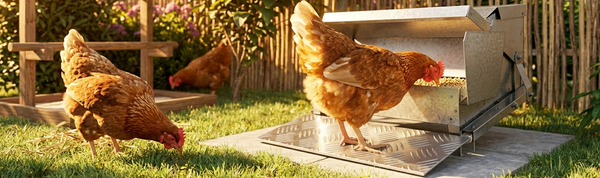
| Best feeder type | Hanging tube or automatic feeder | Automatic, treadle, or fully enclosed feeder |
Shop VetraPulse
Find the Right Feeder for Your Flock
Browse our full range of poultry feeders — from hanging tube designs to weatherproof outdoor options — all engineered for easy height adjustment and low-waste feeding.
🐔 Browse All Feeders🔢 How Many Feeders Does Your Flock Need?
Even a perfectly positioned feeder can become a bottleneck once your flock grows past 6–8 birds. The standard recommendation from poultry welfare researchers: one round/tube feeder per 6–8 hens, or 1 linear foot of trough space per 3–4 birds. [3]
Moving from one feeder to two alone improves intake uniformity from 48% to 69% — a 21-point gain that directly translates to more consistent nutrition, less pecking-order-driven stress, and steadier egg production across the flock. The returns level off somewhat beyond 4 feeders, but for flocks over 15 birds, 3–4 feeders distributed across the coop and run is a sound standard.
📋 The 7-Point Feeder Placement Checklist
Use this to audit your current setup or plan a new one from scratch. One change at a time, one week of observation — most keepers see a measurable difference within the first two weeks.
Match height to your breed
Measure back height of your most common breed. Set the feeder lip to match. Re-check as young birds grow — chicks need feeders adjusted upward every 3–4 weeks until they reach adult size.
Move away from corners
Position in the center of the coop or against a wall with at least 180° open access. If corner placement is unavoidable, use two feeders on adjacent walls so no single bird can block both.
Position 3–6 feet from water
Close enough for easy drink-eat cycles; far enough that dripping beaks don't contaminate feed or create damp spots that invite mold growth.
Clear roosts by at least 4 feet
No feeder should be directly below or adjacent to roosting bars. Droppings contamination is a major biosecurity risk and a fast way to spread Marek's disease and coccidia through the flock.
Ensure adequate light at the feeder
Position near a window or add supplemental lighting (10–20 lux at feeder level). Prioritize morning light exposure, which aligns with the peak feeding window in the natural bimodal rhythm.
Add a second feeder at 8+ birds
Flocks above 8 birds benefit significantly from multiple feeding stations. Distribute across the space — not clustered together — to prevent dominant birds from patrolling both at once.
Shelter any outdoor feeder from weather
A 24-inch overhead shelter minimum protects feed from rain, dew, and direct sun. Elevate on a rubber mat or low platform (2–4 inches) to prevent ground contamination and tipping on soft soil.
How Relocating One Feeder Saved Sarah $190 a Year
Sarah runs a mixed flock of 18 hens (Australorps, Buff Orpingtons, and Leghorns) on a 2-acre homestead in central Tennessee. She was burning through a 50-lb bag of layer pellets every 9 days — faster than her flock size warranted. The feeder: a basic round tray pressed into the southeast corner of her 12×12 coop, sitting flat on the floor with no mat.
She tracked feed consumption weekly for 8 weeks, making one change at a time. Three compounding problems emerged: the corner location let her dominant Leghorns block access entirely during peak feeding windows, the floor-level placement triggered constant bill-sweep scatter from her Leghorns' characteristic side-to-side feeding motion, and poor light near the corner meant her shyer Orpingtons weren't approaching until mid-morning — well outside the peak bimodal window.
Her three changes: hanging the feeder at 8 inches in the center-rear wall, adding a second feeder in the covered run, and installing a single LED strip (15 lux) overhead near the feeding zone. No new feeder model. Same feed, same flock. Feed consumption dropped from 50 lbs every 9 days to 50 lbs every 15.4 days.
🤖 Why Automatic Feeders Solve the Placement Puzzle
Once you understand the variables above, it's clear why automatic feeders consistently outperform traditional designs in real-world flocks — and why they make the placement equation significantly easier to get right.
💡 In comparative placement trials, flocks using well-positioned automatic feeders showed up to 27% higher feed conversion efficiency versus identical flocks using floor-level open trays — a difference primarily attributed to elimination of scatter waste and improved access distribution. [4]

⭐ Featured Product
VetraPulse Automatic Chicken Feeder
Timed dispensing. Sealed chamber. Height-adjustable mount. Built for backyard flocks that deserve better than an open tray on the floor.
Shop Automatic Feeder → View All Feeders❓ Frequently Asked Questions
Tap any question to read the answer.
How high should a chicken feeder be off the ground?
Set the feeder lip at the bird's back height — roughly 6–10 inches for standard laying breeds (Leghorns, Rhode Island Reds, Australorps). Bantam breeds need 4–6 inches; heavy meat breeds like Cornish Cross need 10–13 inches. The practical test: a hen should be able to eat with her head level, not bent below her chest or stretched upward. For mixed flocks, set height for your smallest breed and use multiple feeders if needed.
Where is the best place to put a chicken feeder in the coop?
The best position is away from corners, roosting bars, and nesting boxes, in a well-lit area with 180–360° bird access. Center placement is ideal. Maintain at least 4 feet of clearance from roosts overhead (to prevent droppings contamination), and position 3–6 feet from the waterer. Avoid areas with drafts or direct moisture exposure.
Can I put the feeder outside in the run?
Yes — outdoor run feeders are excellent for reducing indoor crowding and encouraging foraging. However, they must be sheltered from direct rain and prolonged sun exposure, which degrades feed quality rapidly. Elevate the feeder on a rubber mat or low platform to prevent tipping and ground-level contamination. For outdoor use, enclosed, treadle-style, or automatic feeders are strongly preferred over open trays to minimize pest access.
How many feeders do I need for my flock?
The standard guideline is one round or tube feeder per 6–8 hens, or one linear foot of trough space per 3–4 hens. For a 12-bird flock, two feeders placed in different zones of the coop or run will significantly improve feed distribution uniformity. Research shows moving from 1 to 2 feeders improves intake equity from ~48% to ~69% uniformity in a 20-bird flock.
Does feeder placement affect egg production?
Yes — indirectly but measurably. When lower-ranking hens are consistently excluded from the feeder by dominant birds (a problem amplified by poor placement), they receive less protein and energy. This nutritional shortfall can reduce individual egg production by 10–20% in affected birds. Optimizing feeder placement — particularly adding multiple well-spaced stations — helps ensure the entire flock maintains consistent nutritional intake and steady laying output.
What is the best type of feeder to reduce waste?
Enclosed automatic feeders and treadle-activated feeders consistently show the lowest waste rates — as low as 3–6% of total dispensed feed — compared to 25–35% for open trough designs. These designs prevent bill-sweep scatter, weather contamination, and pest access. When combined with correct height and placement, they represent the most feed-efficient option available for backyard flocks of any size.
Should I put the feeder near the nesting boxes?
No. Feeders near nesting boxes disrupt hens during laying, increasing stress and reducing egg production. Feeding traffic also introduces dust and commotion into an area that benefits from quiet and cleanliness. Keep feeders at least 2–3 feet from nesting boxes, or on the opposite side of the coop where layout allows.
How do I know if my feeder placement is wrong?
Watch your flock during the first 2 hours after sunrise — the peak feeding window. Warning signs of poor placement: hens clustering and jostling rather than spreading out calmly, subordinate birds hovering near the feeder but not eating, significant feed on the ground around the feeder, dominant birds guarding the feeder between meals, and faster-than-expected feed consumption without obvious weight gain. Any of these signals suggests a placement issue worth investigating with the 7-point checklist above.
[2] Wageningen University & Research, Poultry Research Group, "Daily Feeding Rhythms in Commercial Layer Hens," 2021.
[3] Poultry Science Association, "Feeder Design, Placement, and Feed Distribution in Small Flocks," 2019.
[4] North Carolina State University Poultry Extension, "Feed Conversion Efficiency and Feeder Height Trials," 2020.
[5] University of Georgia Poultry Science Dept., "Water Proximity Effects on Feeding Behavior," 2022.
[6] British Poultry Science Journal, "Biosecurity Considerations in Small Flock Housing," Vol. 63, 2022.
[7] University of Guelph Poultry Centre, "Light Exposure and Voluntary Feeder Visit Frequency in Layer Hens," 2020.
🌿 The Bottom Line
Feeder placement is one of the highest-leverage, lowest-cost optimizations available to any backyard chicken keeper. The science is consistent: height, horizontal position, water proximity, roost clearance, lighting, and feeder count all interact to shape how your flock eats — every single day.
Most keepers see meaningful results within two weeks of making even one placement correction. Start with height. Then address position. Add a second feeder if your flock is above 8 birds. Track your feed consumption weekly and watch how behavior at the feeder changes.
When you're ready to make placement even easier — and eliminate scatter waste at the source — explore the full VetraPulse feeder collection, or start with our automatic chicken feeder, designed from the ground up for height-adjustable, low-waste feeding in any coop layout. 🐔