Independent buying guide · Updated 2026
Ten energizers ranked on output energy, power source flexibility, monitoring, weather sealing and cost per joule.
Short answer: The best power fence option for most properties is the Gallagher M300, a 3 joule mains energizer with a built in voltage bar graph that covers roughly 85 acres of multi wire fence. For anyone who needs one unit to cover several very different jobs, the VetraPulse Multi Powered 2J/3J/5J charger is the strongest pick because it lets output energy and voltage be dialled up or down and runs on either mains or a 12 volt battery.
What this guide covers
- The 10 picks at a glance
- Full comparison table
- The ranking, one by one
- Output energy and cost per joule
- Stored joules against output joules
- How much voltage each animal needs
- The grounding rule almost nobody follows
- Mains, battery or solar
- Homes, yards and business perimeters
- How this ranking was put together
- Frequently asked questions
- Sources
Most people buying a power fence system start at the wrong end. They pick wire, posts and insulators first, then grab whatever fence charger is sitting on the shelf at the farm store. Six weeks later the cattle are in the neighbour's alfalfa and the charger gets blamed.
The energizer is the only part of an electric fencing system that is genuinely hard to substitute. Wire is wire. Insulators are cheap. But an undersized charger cannot be fixed with better installation, and an oversized one is money that could have gone into ground rods where it would have done more good.
This guide ranks ten power fence options across mains, battery and solar, one model per brand, from small residential runs up to commercial cattle perimeters. Ratings were built from published manufacturer specifications, retail pricing at the time of writing, extension service guidance on sizing and grounding, and what long term owners actually report on ranching and hunting forums.
The 10 picks at a glance
| Rank | Model | Best for | Rated energy | Power source |
|---|---|---|---|---|
| 1 | Gallagher M300 | All round permanent farm fence | 3.0 J stored | Mains |
| 2 | VetraPulse Multi Powered 2J/3J/5J | One unit across mixed jobs | 2.0 / 3.0 / 5.0 J selectable | Mains or 12 V DC |
| 3 | Parmak Magnum Solar-Pak 12 | Off grid pasture | 1.1 to 3.1 J output | Solar with battery |
| 4 | Zareba EAC50M-Z | Straightforward value | 2.0 J output | Mains |
| 5 | Patriot PMX350 | Large acreage on a budget | 3.5 J | Mains |
| 6 | Cyclops Champ | Heavy brush and lightning country | 5.0 J output | Mains |
| 7 | Premier 1 PRS Pro 100 Solar | Electric netting and strip grazing | 1.0 J output | Solar with battery |
| 8 | Nemtek Druid 15 LCD | Home and business perimeters | 4.6 J output | Mains with battery backup |
| 9 | American FarmWorks 240 Mile | Very large wire runs | 15 J | Mains |
| 10 | Dare 75 Mile AC | Simple small property fencing | 3.0 J stored | Mains |
Manufacturers publish energy differently. Some quote stored joules, some quote delivered output. The difference is explained further down.
Full comparison table
| Model | Rated energy | Claimed coverage | Voltage control | Monitoring | Weather rating | Price at writing |
|---|---|---|---|---|---|---|
 Gallagher M300 Gallagher M300
|
3.0 J stored | 85 acres / 17 miles | Fixed | Voltage bar graph | Indoor mount | ~$230 |
 VetraPulse Multi Powered VetraPulse Multi Powered
|
2.0 / 3.0 / 5.0 J | 6.2 miles | 8, 10 or 12 kV | Numeric LED display + alarm | IP65 | $129 |
 Parmak Magnum Solar-Pak 12 Parmak Magnum Solar-Pak 12
|
1.1 to 3.1 J output | 30 miles | Fixed | Analogue performance meter | Weatherproof outdoor | ~$400 |
 Zareba EAC50M-Z Zareba EAC50M-Z
|
2.0 J output | 50 miles | Fixed | Indicator light | Indoor mount | ~$157 |
 Patriot PMX350 Patriot PMX350
|
3.5 J | 200 acres / 65 miles | Fixed | Indicator lights | Indoor mount | ~$144 |
 Cyclops Champ Cyclops Champ
|
5.0 J output | Large multi strand | Fixed | Fence load detector | Indoor mount | ~$330 |
 Premier 1 PRS Pro 100 Premier 1 PRS Pro 100
|
1.0 J output | Netting and strip grazing | Fixed | Status lights | Sealed, outdoor | Check price → |
 Nemtek Druid 15 LCD Nemtek Druid 15 LCD
|
4.6 J output | Single zone perimeter | Adaptive power | LCD with fault colours | IPx4 | Check price → |
 American FarmWorks 240 Mile American FarmWorks 240 Mile
|
15 J | 240 miles | Fixed | Fence OK light | Weather resistant housing | Check price → |
 Dare 75 Mile AC Dare 75 Mile AC
|
3.0 J stored | 75 miles | Fixed | Indicator light | Indoor mount | Check price → |
Coverage figures are manufacturer claims measured on clean wire with no vegetation load. Treat them as a ceiling, not a working number.
The ranking, one by one
Gallagher M300
Gallagher · mains powered · New Zealand engineering
The M300 sits in the middle of Gallagher's mains range and it is the unit most dealers reach for when someone describes a normal farm. Three stored joules will carry a multi wire permanent fence over roughly 85 acres in good conditions, and it will run up to six electric nets, which is unusual for a plug in unit at this price.
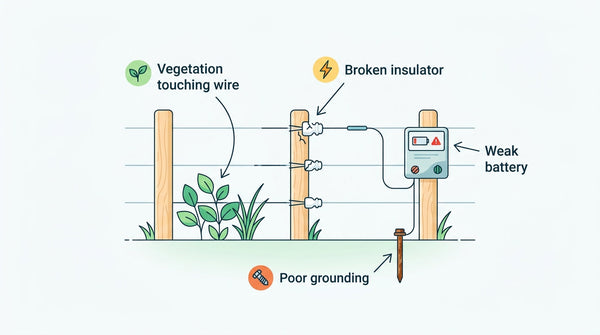
What separates it from cheaper plug in chargers is the quick scan bar graph on the front. Instead of a single light that tells you the unit has power, the bar graph shows output voltage at a glance, so a slow decline caused by a cracked insulator or creeping vegetation shows up before the animals find it. Built in lightning protection is standard.
STRENGTHS
- Voltage bar graph makes faults visible early
- Handles multi wire fence and netting
- Long service reputation among dealers
TRADE OFFS
- Must be mounted under cover
- Owners report parts are sold as whole assemblies
- Costs more per joule than most rivals here
VetraPulse Multi Powered Electric Fence Charger, 2J/3J/5J
VetraPulse · mains or 12 V DC · selectable energy and voltage
Unlike fixed-output energizers that require a separate unit for each application, the VetraPulse adjusts output energy (2, 3, or 5 joules) and voltage (8, 10, or 12 kV) from the front panel. That matters practically: MSU Extension recommends three feet of ground rod per joule, so a 5 J unit needs fifteen feet of rod. Being able to dial down to 2 J for a short poultry run and up to 5 J for a cattle perimeter means one purchase covers both jobs.
The real-time LED voltage display and fault alarm set it apart from the blinking-light norm under $200 — shorts get noticed from the yard, not discovered mid-walk with a tester. IP65 housing allows pole mounting at the fence, eliminating the long lead wire responsible for most voltage drop complaints.
At $129 for up to 5 joules it is the cheapest energy-per-dollar unit in this ranking by a significant margin. The main caveat: only 14 buyer reviews at time of writing, a much younger track record than legacy brands like Parmak or Zareba.
STRENGTHS
- Output energy and voltage both adjustable
- Runs on mains or a 12 V battery with no adapter kit
- Numeric voltage display and fault alarm
- IP65 sealed, mounts outdoors at the fence
TRADE OFFS
- Newer brand with a smaller review history
- Tops out at 5 joules, so very long high tensile runs need a dedicated mains unit
- Solar use requires a separate panel
Parmak Magnum Solar-Pak 12 Electric Fence Charger
Parmak · solar with sealed 12 V battery · made in the USA
This is the solar unit that keeps getting recommended by people who have already burned through two cheap ones. Parmak builds it entirely in house in the United States, backs it with a three year warranty that covers lightning damage, and fits an analogue performance meter that shows fence condition without any extra tools.
Output runs from 1.1 up to 3.1 joules depending on load, which puts it far above the 0.15 joule farm store solar units that struggle the moment grass touches the wire. Buyers on eBay listings repeatedly say it holds voltage better than the discount solar models they replaced, including through weeds and brush.
STRENGTHS
- Genuine pasture level output from a solar unit
- Three year warranty covering lightning
- Built in meter, no separate tester needed
TRADE OFFS
- The most expensive unit per joule in this guide
- Sealed battery ages and eventually needs service
- Cold weather reduces battery reserve like all solar units
Zareba EAC50M-Z
Zareba · mains powered · low impedance, UL listed
Two output joules through a low impedance circuit is enough for a normal cattle or horse perimeter on two or three strands, and Zareba sells it for meaningfully less than the comparable Parmak and Patriot mains units. It is UL listed, made in the United States, and there is essentially nothing to learn before installing it.
The catch is that it does exactly one thing. No battery input, no solar option, no display. If the power goes out the fence goes dead, which is fine near a barn and a poor idea on a remote boundary.
STRENGTHS
- Strong price for a real 2 output joules
- Handles heavy weed conditions
- Warranty covers lightning damage
TRADE OFFS
- Mains only, no backup power path
- Single indicator light instead of a voltage reading
- Needs indoor or covered mounting
Patriot PMX350
Patriot · mains powered · low impedance
Patriot has quietly become the value answer to Gallagher. The PMX350 puts 3.5 joules into a fence rated for around 200 acres and sells well below what a similarly rated Gallagher costs, which is exactly the comparison ranchers make on forums when the topic comes up.
It is a plain unit. Indicator lights rather than a display, mains only, mount it inside. But the pulse is honest and the price per joule is the second best in this ranking.
STRENGTHS
- Large coverage for the money
- Low impedance handles vegetation load
- Widely stocked, easy to replace
TRADE OFFS
- No voltage reading
- Mains only
- Some owners note plastic parts feel light
Conductor choice matters as much as the charger. Polywire loses voltage over distance far faster than high tensile steel.
Cyclops Champ
Cyclops by Taylor Fence · mains powered · built in Alabama
Cyclops chargers are built by Taylor Fence in Alabama and the whole line is designed around two problems that kill energizers in the field: vegetation load and lightning. The Champ delivers five output joules through a low impedance design that keeps controlling voltage on the wire when grass and brush are dragging on it.
The lightning story is the part owners talk about. Heavy surge suppression and a built in fence load detector are standard across the range, and parts are replaceable rather than sealed into one assembly.
STRENGTHS
- Serious output for overgrown fence lines
- Strong surge and lightning protection
- Individually replaceable parts
TRADE OFFS
- Needs six ground rods on the larger units
- One year base warranty unless extended
- Mains only, no display
Premier 1 PRS Pro 100 Solar
Premier1Supplies · solar with twin batteries · suitcase format
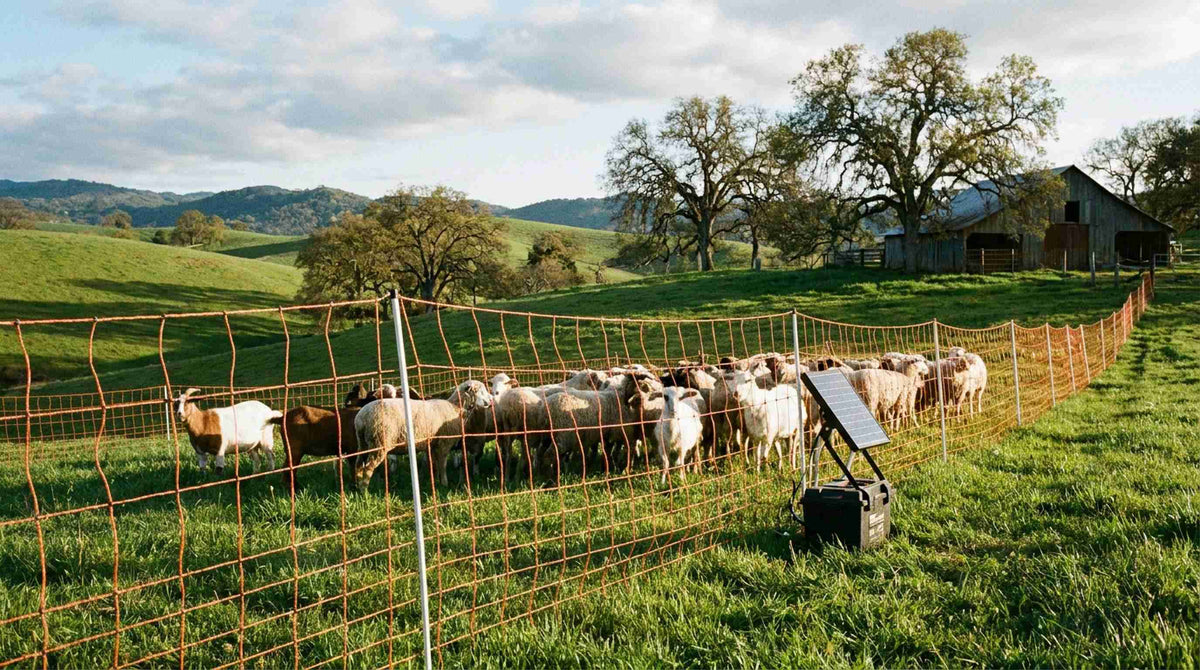
Premier designed this because, in their own words, most farm store solar units are too weak in output joules to properly energize netting. That is not marketing spin. Electric netting presents a much heavier load than plain wire, and a 0.15 joule unit simply cannot hold voltage across it.
The PRS Pro 100 gives a full output joule, uses a 15 watt glass solar panel rather than plastic, and carries two 15Ah batteries for around six sunless days of reserve. There is a 110 volt port so it can run without a battery when parked near power. For rotational graziers moving netting every few days it is the most practical unit in this ranking.
STRENGTHS
- Enough output to actually energize netting
- Glass panel outlasts plastic panels in sun
- Six day reserve with twin batteries
- Suitcase build made for constant moving
TRADE OFFS
- Premium pricing for one joule
- Overkill for a static wire perimeter
- Battery capacity still drops in deep cold
Nemtek Druid 15 LCD
Nemtek · mains with battery backup · security energizer
This is the only genuinely security oriented unit in the ranking, and it belongs here because the question of how to protect a yard, a depot or a commercial boundary is not the same question as how to hold cattle. Nemtek has built security energizers for more than three decades and the Druid 15 is their single zone workhorse.
It gives 4.6 output joules with adaptive power technology to reduce arcing and false alarms, an LCD that changes colour with fence condition, tamper alarms on both the high voltage and earth wires, gate monitoring input, and the option to connect to an armed response system. None of that is relevant to a paddock. All of it is relevant to a perimeter that people rather than livestock are testing.
STRENGTHS
- Tamper and fault alarms built in
- Colour coded LCD shows fence state instantly
- Battery backup and surge protection standard
- Integrates with monitoring services
TRADE OFFS
- Usually needs professional installation
- IPx4 rating means it wants a sheltered mount
- Availability varies a lot by country
American FarmWorks 15 Joule 240 Mile AC
American FarmWorks · mains powered · sold through Tractor Supply
Fifteen joules is a lot of energizer. This unit is aimed at operations running enormous wire mileage, works in heavy wet weed conditions, and uses a fuseless design in a weather resistant housing. Being stocked at Tractor Supply means a failure on a Saturday is a drive rather than a shipping wait.
It ranks ninth despite the raw numbers because power alone does not make a good energizer. Monitoring is a single Fence OK light, and by extension service guidance a 15 joule output demands around 45 feet of ground rod to work as intended. Most buyers at this level do not install that, and the unit then underperforms a much smaller charger with proper grounding.
STRENGTHS
- Enormous output for the money
- Designed for wet, weedy conditions
- Easy to source locally
TRADE OFFS
- Requires roughly 45 feet of ground rod
- No voltage reading at all
- Far more energy than most properties need
Dare 75 Mile AC Energizer
Dare Products · mains powered · US manufacturer since the 1950s
Dare has been making electric fencing in the United States for around seventy years and distributes mainly through co ops and buying groups rather than direct retail. The 75 mile AC unit is about as basic as a modern energizer gets: three stored joules, a steel and plastic housing, one light.
It lands at the bottom of this ranking not because it is bad but because everything above it offers something extra for a similar outlay. If a fence is short, the outlet is close and the goal is simply a working pulse, this is a perfectly reasonable purchase.
STRENGTHS
- Long established US manufacturer
- Simple enough that little can go wrong
- Good availability through farm co ops
TRADE OFFS
- Stored joules rather than output, so real delivery is lower
- No display, no battery option
- Thin online review base compared to major brands
Output energy and cost per joule
Two numbers decide most of this ranking. How much energy the unit actually delivers, and what that energy costs. Here is how the picks compare on the first.
Maximum rated energy by pick
Joules, as published by each manufacturer. The American FarmWorks unit at 15 J sits outside this scale and is excluded so the everyday bracket stays readable.
Raw energy on its own is a poor guide though. What matters to anyone spending money is how much of it a dollar buys. Dividing price at time of writing by maximum rated energy gives a rough but revealing figure.
Cost per rated joule
Retail price at time of writing divided by maximum rated joules. Lower is better. Solar units include a panel and a battery, so they are structurally more expensive per joule and should be read separately.
Prices move constantly. Recalculate before buying rather than trusting a figure from any review, including this one.
Stored joules against output joules
This is the single most useful thing to understand before comparing any two chargers, and it is the thing manufacturers are quietest about.
Stored joules describe how much energy the capacitor holds. Output joules describe how much of it actually reaches the fence. The gap between the two is real, and industry sizing guides commonly put delivered output at somewhere between half and seventy percent of stored energy. So a charger advertising 3 stored joules is not equivalent to one advertising 3 output joules. It is meaningfully weaker.
Which is why the comparison table above separates the two rather than lumping them together. Gallagher and Dare publish stored figures. Zareba, Cyclops, Parmak and Premier publish output. When a spec sheet does not say which, assume stored, because that is the flattering number.
The mileage claim problem
Powerflex Fence puts the working rule at roughly one output joule for every three miles of average agricultural fence carrying an average vegetation load, and notes that manufacturer claims of ten miles per joule come from laboratory conditions rather than a working ranch. Applied honestly, a 6 mile claim on a real fence with real grass is closer to a 2 mile fence.
How much voltage each animal needs
Joules get an animal's attention. Voltage is what pushes the pulse through hair, wool and hide. Different species need genuinely different numbers, and this is where an adjustable unit earns its keep and a fixed one either wastes energy or falls short.
| Animal | Minimum working voltage | Why |
|---|---|---|
| Cattle | 2,000 to 3,000 V | Thin hair, large body, easy contact with the wire |
| Horses | 2,000 to 2,500 V | Sensitive and quick to learn a boundary |
| Sheep and goats | 4,000 to 5,000 V | Wool and hair insulate heavily against the pulse |
| Predators and wildlife | 5,000 V and above | Thick coat plus strong motivation to push through |
The practical consequence is that a property running cattle in one paddock and goats in another is asking one energizer to do two jobs with very different voltage requirements. Fixed units get sized for the harder job and then run hot on the easier one, which wastes battery and shortens component life on the DC side.
The grounding rule almost nobody follows
Michigan State University Extension is direct about this. An energizer is only as effective as the grounding system installed with it, and the general rule is a minimum of three feet of ground rod per joule of output capacity. A 15 joule charger therefore wants around 45 feet of rod in the ground, spaced at least ten feet apart, driven into the moistest soil available.
Almost nobody does this. The typical installation is one rod, sometimes two, next to the charger. Then the fence tests at 4,000 volts on a dry August afternoon and nobody can work out why the goats keep leaving.
Minimum ground rod length by output energy
Based on Michigan State University Extension guidance of three feet of rod per output joule.
Read that chart alongside the energy chart and a pattern appears. Buying the biggest charger available makes the grounding job dramatically harder. There is a strong argument for choosing an energizer whose output can be matched to the grounding actually installed, rather than committing to a fixed number and hoping the soil cooperates.
Mains, battery or solar
Mains units are cheapest per joule, unaffected by cold, and best for heavy vegetation. That is not opinion, it is what Premier1 states plainly in their own selection guidance, and they sell solar units. The trade off is that mains needs a cable run and the fence dies with the power.
Solar removes the cable and the running cost. It also introduces a battery, and batteries lose capacity in cold weather. Several of the roundups published this year make the same point: lead acid solar chargers can shed a large share of their effective capacity once temperatures fall below freezing. Anyone fencing through a northern winter should size the solar unit far above what the summer load suggests.
Dual power units sit in between. A charger that accepts both mains and 12 volt input can be plugged in near the barn during winter and moved onto a battery for a remote summer paddock, and the same box handles both. That flexibility is the main reason dual input models appear at the top of most current comparison lists rather than pure mains ones.
Homes, yards and business perimeters
Electric fencing on a residential or commercial boundary is a different product category wearing similar clothes. Livestock energizers are designed to teach an animal a lesson it will remember. Security energizers are designed to detect tampering, raise an alarm, and keep working when someone deliberately cuts the earth wire.
Three things matter most on this side. Zone monitoring, so a fault on one wall does not disable the whole perimeter. Alarm output, so the fence can talk to a monitoring service. And battery backup, because an intruder cutting mains power should not disable the barrier.
Livestock chargers do none of that. They will electrify a boundary, and for a rural property protecting a chicken run from foxes that is entirely appropriate. For a commercial yard it is not. Regulations on security electric fencing differ enormously between countries and often between municipalities, covering signage, maximum energy, height and installer certification, so local rules should be confirmed before anything gets bought.
How this ranking was put together
Every unit here was assessed on published manufacturer specifications, retail pricing observed at the time of writing, and third party sizing guidance from agricultural extension services rather than marketing material. Where owner feedback is quoted it comes from public forum threads on Ranchers.net, TexasBowhunter and Rokslide, or from verified retail reviews, and is paraphrased rather than reproduced.
One model per brand was allowed, which is why several strong alternatives from the same manufacturers do not appear. Ranking weighted five factors: delivered energy against price, power source flexibility, quality of fault monitoring, weather protection and mounting freedom, and the depth of independent owner feedback available. Nothing here was tested in a laboratory, and no claim in this article should replace reading the manual that ships with the unit.
Frequently asked questions
Can one energizer run more than one separate fence line?
Yes, provided the combined wire length and vegetation load stay inside the unit's real capacity rather than its advertised mileage. Multiple lines are wired in parallel from the same fence terminal. The catch is diagnosis: with three lines on one charger, a short on any of them drags all three down, and finding it means disconnecting each in turn. Units with a numeric voltage display make that process much faster than units with a single light.
Is it safe to leave an energizer running during a thunderstorm?
The energizer itself is usually fine if it has built in lightning protection, but the fence line acts as a long antenna and a nearby strike can travel down it. Several manufacturers, including Parmak and Zareba, cover lightning damage under warranty precisely because it is the most common cause of failure. In areas with frequent strikes a dedicated lightning diverter fitted between the charger and the fence is worth the small cost.
Will a power fence hurt a child or a pet dog?
A properly built livestock energizer delivers a short, high voltage, very low current pulse designed to startle rather than injure. It is unpleasant and it is meant to be. Certified units are engineered to fixed international safety limits on pulse energy and interval. That said, higher joule chargers hurt considerably more, warning signage is a legal requirement in many places, and any electric fence within reach of small children should be sited and signed accordingly.
How long should a fence charger last before it needs replacing?
Mains units with no battery routinely run ten years or more, since there is little inside to wear out apart from capacitors and surge components. Solar and battery units are limited by the battery, which typically gives around five years of normal service before capacity drops enough to matter. Units where the battery can be replaced separately last far longer in practice than sealed designs that need factory service.
Does frozen or snow covered ground stop an electric fence working?
It weakens it substantially. The pulse must return through the soil to the ground rods, and frozen ground conducts poorly, so voltage at the animal drops even though the charger is working perfectly. Snow lying on the bottom wire also insulates hooves from the earth. The usual fixes are driving ground rods deeper into unfrozen soil, adding extra rods, or switching to an earth return system where a dedicated return wire carries the pulse back instead of the soil.
Can the same charger be used for a garden one season and cattle the next?
Only if it has enough headroom for the harder job. A garden barrier against rabbits and raccoons needs very little energy, while cattle on multiple strands need considerably more, and a unit sized for the garden will not scale up. Sizing for the largest future requirement is the safer approach, and adjustable output models remove the guesswork because the setting can be moved as the job changes.
What does it cost to run a mains energizer for a year?
Very little. Typical farm energizers draw somewhere in the region of 10 to 40 watts continuously, which at average domestic electricity rates works out to roughly the cost of leaving a couple of light bulbs on. Running cost is almost never the deciding factor between mains and solar. Cable distance and grid reliability are the real considerations.
Why does my fence read high voltage but animals still get through?
Usually because the tester is measuring voltage with no load on it. A fence can read 6,000 volts on an open circuit and collapse to almost nothing the moment an animal makes contact, if the energizer lacks the joules to sustain the pulse or the grounding cannot complete the circuit. Low impedance chargers exist specifically to hold voltage under load. Testing while deliberately loading the fence gives a far more honest reading than testing it clean.
Can two chargers be wired to the same fence to double the power?
No, and doing it risks destroying both. Two energizers pulsing independently onto the same conductor will fight each other and can drive damaging voltage back into the output circuitry. If more power is needed the correct answer is a single larger charger, or splitting the fence into separate isolated sections with one charger each and no electrical connection between them.
Does an outdoor rated energizer really matter?
It matters more than most buyers expect, because it changes where the unit can live. An indoor only charger has to sit in a shed or barn, which usually means a long insulated lead out wire running to the fence, and that wire is a frequent source of voltage loss and rodent damage. A sealed unit rated IP65 or better can be mounted on a post at the fence itself, which shortens the lead out to almost nothing.
Sources
- Michigan State University Extension, Considerations for Selecting and Installing an Electric Fence Charger
- Michigan State University Extension, Grounding the electric fence
- University of California Agriculture and Natural Resources, Electric Fence reference sheet
- Powerflex Fence, Electric Fence Voltage Requirements by Livestock
- Parmak, Magnum Solar-Pak 12 product specifications
- Premier1Supplies, PRS Pro 100 Solar Energizer
- Cyclops Fence by Taylor Fence, Cyclops energizer information hub
- Tractor Supply, American FarmWorks 15 Joule 240 Mile AC charger
- Nemtek, Residential security energizers
- Ranchers.net forum, Fence chargers discussion thread
- TexasBowhunter forum, Best solar fence charger thread
- Rokslide forum, Portable fence charger discussion
- Ranch Approved, Best Electric Fence Chargers for Cattle in 2026
- VetraPulse, Multi Powered Electric Fence Charger specifications