Electric Fence Troubleshooting: How to Find and Fix Low Voltage Fast
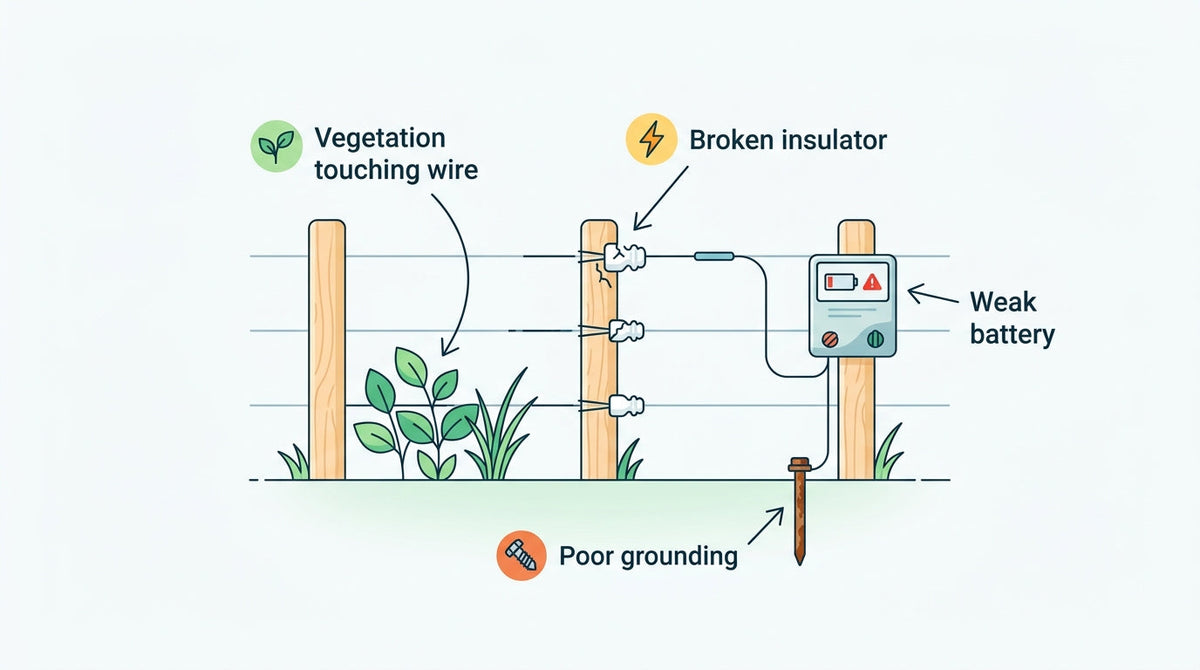
Quick answer: If your electric fence is weak or dead, test the energizer by itself first — it should read about 7,000–9,000 volts across its terminals with the fence disconnected. If the energizer is fine, the problem is almost always poor grounding, a broken insulator, vegetation touching the wire, or a bad connection somewhere along the line.
Table of Contents
Know Your Baseline Voltage Before Anything Breaks
You can't troubleshoot what you never measured. Virginia Cooperative Extension recommends keeping fences at a minimum of 3,000–5,000 volts for cattle and around 7,000 volts for sheep, whose wool insulates them from lighter shocks. Voltage naturally drifts with soil moisture and grass load through the seasons, so testing your fence every week or two when it's healthy tells you what "normal" looks like on your farm.
Recommended minimum fence voltage (volts)
One tool matters more than any other here: a digital voltmeter or fault finder that gives a numeric reading in kilovolts. The cheap five-light testers can tell you a fence is "on," but they can't show you a slow slide from 6.5 kV to 3 kV — and that slide is the early warning most people miss. Fault finders that also read amps will even point an arrow toward the direction of the short, which can save you an hour of walking.
 A digital fence tester with a numeric kV readout is the single best troubleshooting investment.
Step 1: Test the Energizer by Itself
Before blaming the fence, isolate the box. This two-minute test settles half of all "my fence is dead" mysteries:
1. Turn off and unplug the energizer.
2. Disconnect both the fence lead and the ground lead from its terminals.
3. Power it back on with nothing attached.
4. Put your tester's probe on the positive terminal and its ground clip on the negative terminal.
A healthy energizer pulses at roughly 7,000–9,000 volts on this open-circuit test. If it reads strong here but weak on the fence, your charger is fine — the problem lives outside the box. If it reads low or dead, check the fuse and look inside for black carbon deposits, which are the classic signature of lightning damage. An energizer with visible carbon scoring usually needs repair or replacement.
Step 2: Check the Grounding System (The Usual Suspect)
An electric fence is only half wire. The pulse has to travel through the animal, into the soil, and back to the energizer through the ground rods — if that return path is weak, the whole fence feels weak, no matter how big the charger is. This is the part almost everyone underbuilds, and it's the first thing experienced graziers on forums like CattleToday tell newcomers to fix.
Grounding problems love to hide because they're seasonal. A system that tested fine in a wet spring can fall apart in an August drought when the soil dries out and loses conductivity. You may need extra rods if you installed during wet weather, upgraded to a bigger energizer, or couldn't drive the original rods to full depth. In chronically dry or rocky ground, placing rods in the dampest spot available — or backfilling with bentonite to hold moisture — makes a real difference.
 Three connected galvanized rods, six feet deep and ten feet apart, solve most chronic low-voltage complaints.
Step 3: Walk the Line and Find the Fault
If the energizer and grounding both check out, the fault is on the fence. Here's the logic that makes fault-finding fast instead of frustrating: voltage is the pressure between wire and soil, and amps are current actually flowing. A big voltage drop paired with a big amp spike means current is escaping somewhere — a wire against a steel T-post, a cracked insulator, a fallen branch, a section of downed wire.
Start at the energizer and test on both sides of critical points like gates and lane crossings. When a low-voltage/high-amp reading suddenly flips to high-voltage/low-amp in the next section, you just walked past the fault. Cutout switches are worth installing for exactly this reason — they let you kill half the fence and instantly narrow the search.
Two faults that fool almost everyone: buried lead-out wire under gateways whose insulation has been worn through by rocks (always sleeve it in conduit), and old poly wire whose tiny steel strands have corroded or snapped internally, so it looks intact while barely conducting. And never overlook the boring one — heavy grass and weeds sagging on the bottom wire will quietly bleed a fence down by thousands of volts.
 Vegetation load is the slowest, sneakiest voltage thief — it builds week by week.
Symptom-to-Fix Cheat Sheet
| Symptom | Most Likely Cause | Fix |
|---|---|---|
| Fence dead, energizer light off | Power supply: tripped outlet, dead battery, blown fuse | Check outlet/fuse; charge or replace battery |
| Energizer clicks but fence reads low everywhere | Poor grounding or corroded lead-out connections | Add ground rods; re-crimp connections with proper clamps |
| Voltage fine near charger, weak far away | Fault mid-line, bad splice, or undersized/poor-quality conductor | Walk the line with a tester; replace hand-twisted joints with crimps |
| Voltage drops after rain | Cracked insulators arcing to posts, vegetation suddenly conductive | Replace suspect insulators; mow the fence line |
| Voltage drops in drought | Dry soil weakening the ground return | Water around rods, add rods, or relocate them to damp ground |
| Snapping/ticking noise at night | Arcing at a loose joint, cracked insulator, or wire near metal | Follow the sound (or an AM radio's static) and tighten/replace |
| Animals walking through a "live" fence | Voltage below deterrent threshold for that species | Fix faults, then verify species-appropriate kV with a tester |
Battery, Solar, and AC Power Problems
Each power source fails in its own way, so match your first check to your setup:
| Power Source | Typical Failure Mode | First Check |
|---|---|---|
| AC / plug-in | Tripped GFCI outlet, lightning surge damage | Test the outlet with another device; inspect for carbon deposits |
| Battery (DC) | Battery deeply discharged and sulfated from running flat | Measure battery voltage under load; recharge before it's fully empty |
| Solar | Dirty or shaded panel; internal battery aging out after a few seasons | Clean the panel, confirm sun exposure, then test the battery |
A detail worth knowing for winter: a solar unit that limps through short, gray days is usually suffering from a tired internal battery rather than a broken panel. And on any battery unit, an energizer that keeps pulsing on a dying battery will often deliver a weaker, slower pulse before it dies entirely — which reads as a "mystery" voltage drop on the fence.
When It's the Charger, Not the Fence
Sometimes the honest diagnosis is that the energizer itself is the weak link: it fails the open-circuit test, it's scarred by lightning, or it was simply never sized for the fence it's driving — a small fractional-joule unit pushed onto miles of wire under grass load will always test "low" no matter how perfect your insulators are. If you've fixed the faults and beefed up the grounding but the numbers still won't climb, upgrading the charger is the fix, not another weekend of walking the line.
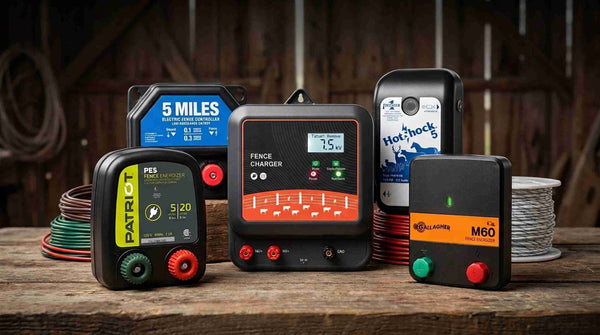
When you shop, think like a troubleshooter: a built-in voltage display lets you spot a developing fault from the barn instead of discovering it after a breakout, multi-power (AC/DC) flexibility means a dead outlet or dying battery never leaves the fence cold, and a weather-sealed housing protects the electronics you just learned are the most expensive part to replace.
Ready for a fence that's easier to keep hot?
Browse energizers with LED voltage displays, AC/DC flexibility, and weather-sealed housings — plus the polywire and accessories to build a fence that troubleshoots itself.
Shop Electric Fencing →FAQ: Electric Fence Troubleshooting
Can I test an electric fence with a regular multimeter?
Not reliably. A fence energizer fires very short high-voltage pulses, and most standard multimeters can't capture a brief 5,000–9,000 volt spike — many will read almost nothing or can be damaged. Use a dedicated fence voltmeter or fault finder designed for pulsed high voltage; they're inexpensive and give a true kV reading.
Will an electric fence still work in snow or frozen ground?
Performance usually drops, because frozen or snow-covered soil conducts poorly and weakens the ground return through the animal's feet. Fences built with an earth-return (hot/ground alternating) wire layout hold up much better in winter, since the circuit completes through a grounded fence wire instead of relying on frozen soil.
Why does my fence shock me but not my animals?
Usually it's insulation on the animal's side: thick winter coats, wool, or dry hooves on dry ground reduce the shock they feel, while your sweaty hand and boots make you an excellent conductor. It can also mean voltage is borderline — enough to sting a person but below the deterrent threshold for that species — so verify with a tester rather than your arm.
Does an electric fence use more electricity when it has a short?
Slightly, yes. A short lets current flow with every pulse, so the energizer works harder and battery or solar units drain noticeably faster. If a battery that used to last weeks suddenly needs charging every few days, treat that as a symptom and go hunting for a fault.
Can I use my home's electrical ground rod for the fence?
No — fence energizers need their own separate grounding system, kept at least 33 feet from utility poles and household or barn grounds. Sharing grounds can push stray voltage into buildings, waterers, and milking equipment, stressing animals and creating problems far harder to solve than a weak fence.
How often should I check my fence voltage?
Once a week is a good rhythm, plus a check after storms, during droughts, and any time animals start testing the line. Regular readings build the baseline that makes every future problem obvious in seconds — a fence that normally sits at 6.8 kV reading 4.1 kV is telling you something even though it's still "working."
Sources
- Virginia Cooperative Extension — Electric Fencing: Troubleshooting (SPES-692P)
- Zareba Systems — Importance of Grounding + 8 Electric Fence Grounding Tips
- CattleToday Forum — Electric Fence Problem: Arcing at Ground Rod (real-user discussion)
- Circle S Farm Supply — Fence Grounding Guide