Buying guide · Updated August 2026
The best value fence charger in 2026 is the Parmak Mark 8 for anyone who can spend around $185, because it delivers up to 4.9 output joules with a built-in digital meter and a 3 year warranty. For buyers who want to stay under $100, the VetraPulse 1J 10kV AC/DC charger at $89.99 is the strongest pick, offering a full 1 joule of output, IP65 weather sealing and AC, battery or solar input, which is roughly twice the punch of most sub $100 plug-ins.
Cheap and good value are not the same thing in this category. A $40 energizer that only pushes 0.1 joules will hold a few laying hens behind clean netting and not much else. Spend another $50 and the output jumps five to ten times. That is why this list is not sorted by sticker price. It is sorted by what each unit does for the money, with a hard ceiling around $190 so nothing here strays into commercial ranch territory.
Four things were weighed for every product. Output joules first, since that number decides whether a goat with a winter coat feels anything at all. Then power flexibility, meaning whether the unit runs on AC only or can also take a 12V battery or a solar panel. Then weather tolerance, because a charger that must live indoors quietly adds the cost of a long lead-out wire or a weatherproof box. Warranty length came last, but it matters more on budget gear than on premium gear, where longevity is rarely in doubt.
Table of Contents
Top 3 picks at a glance
|
BEST UNDER $100 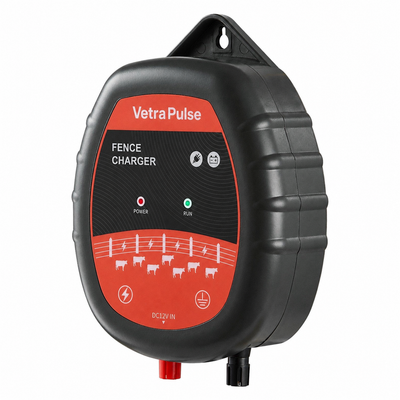
VetraPulse 1J 10kV AC/DC
|
Comparison table
Prices are the listed prices found on the linked retailer or brand page at the time of writing. They move often, so treat them as a starting point rather than a promise.
| # | Charger | Output | Power | Rated range | Price | Action |
|---|---|---|---|---|---|---|
| 1 | Parmak Mark 8 | 1.1 to 4.9 J | AC | 30 mi | $184.99 | Check Price |
| 2 | VetraPulse 1J 10kV | 1.0 J | AC / DC / solar | Small to mid fences | $89.99 | Check Price |
| 3 | Zareba 10 Mile AC | 0.5 J | AC | 10 mi clean / 1 mi weeds | $99.99 | Check Price |
| 4 | Gallagher M60 | 0.34 J out / 0.6 J stored | AC | 10 mi clean / 3 mi typical | $109.99 | Check Price |
| 5 | Premier1 HotShock 5 | 0.5 J | AC or 12V battery | Netting, short fences | $99 to $114 | Check Price |
| 6 | Patriot PE5 | 0.2 J | AC | 5 mi / 20 acres | $54 | Check Price |
| 7 | Epoify 10 Mile Solar | 0.18 J | Solar all-in-one | 10 mi | See listing | Check Price |
| 8 | Happy Henhouse 110V AC | 0.25 J | AC | 2 mi / 8 acres | See listing | Check Price |
| 9 | FenceMate 5 Mile AC | 0.25 J | AC | 5 mi single wire / 1 mi typical | See listing | Check Price |
| 10 | American FarmWorks 5 Mile AC | 0.1 J | AC | 5 mi | See listing | Check Price |
Output joules under $120, charted
The Parmak sits in its own price bracket, so it is left off this chart. Among the nine units that cost $120 or less, here is how the manufacturer-stated output joules line up. Bar length is proportional to the number shown.
Source: manufacturer product pages linked in the Sources section. Gallagher figure is stated output, not stored energy.
The 10 best value power fence chargers
1. Parmak Mark 8: Best Overall Value

Parmak Mark 8 Low Impedance AC Fence Charger
- 1.1 to 4.9 joules output
- Up to 30 miles of fence
- Built-in digital performance meter
- 3 year warranty including lightning
Pros
- Highest output per dollar on this list
- Voltage meter built in
- Long warranty with lightning coverage
- Made in USA, UL listed
Cons
- Indoor installation only
- AC only, no battery or solar option
- Overkill for a chicken run
The Mark 8 is the priciest thing on this page and still the best deal, which says a lot about how output joules are priced. Roughly $185 buys up to 4.9 joules of low impedance output, and that is enough to run a multi-wire cattle fence through wet brush without the voltage collapsing at the far end. The nearest units on this list top out at 1 joule. Per joule, nothing else comes close.
The built-in digital performance meter is the feature that separates it from the rest of the budget field. Reading fence condition from the charger itself, without a separate tester, saves real time on daily checks. Fuse protection and built-in lightning arresters are backed by a 3 year warranty that covers lightning damage. It is an indoor install, so the unit wants a dry spot in a barn or shed and a lead-out wire to the fence.
2. VetraPulse 1J 10kV AC/DC Charger: Best Value Under $100
VetraPulse 1J 10kV Electric Fence Charger, AC/DC, IP65, LED Indicator
- 1.0 joule output at 10 kV, 1 pulse per second
- AC adapter, 12V battery or solar panel input
- IP65 rated, -4°F to 122°F operating range
- LED pulse indicator, free U.S. shipping
Pros
- Only 1 joule unit under $100 here
- Three power inputs in one unit
- IP65, can be mounted outdoors
- Wide temperature range
Cons
- Battery and solar panel sold separately
- No published mile rating, size by animal and wire count
Below $100 the market is mostly 0.2 to 0.5 joule plug-ins, and that is the context that makes this unit stand out. At $89.99 it delivers a full 1 joule at 10 kV with a 1 second pulse rate. That is double the output of the Zareba and Premier1 units ranked just below it, and four to five times what the cheapest picks manage. For anyone running goats, a few head of cattle or a longer poultry net through real vegetation, that extra joule is the difference between a fence animals respect and one they test.
Two design choices push it further up the value scale. The first is power input. It runs on the included AC adapter, on an external 12V lithium battery, or from a solar panel, so one unit covers a barnyard install today and a remote paddock next season. Most plug-ins at this price are AC only. The second is the IP65 rating with a stated operating range of -4°F to 122°F. Several competitors here specify indoor or sheltered mounting, which quietly adds the cost of a long lead-out or an enclosure. This one can sit on the post. An LED flashes with each pulse so a dead fence shows itself from across the yard.
3. Zareba 10 Mile AC Charger: Best USA-Made Budget Plug-In

Zareba 10 Mile AC Low Impedance Charger, EAC10M-Z
- 0.5 joule output, up to 10,500 volts
- 10 miles clean wire, 5 miles poly, 1 mile heavy weeds
- Fence OK indicator light
- Made in USA
Pros
- Proven reliability
- Realistic range ratings
- Works with every wire type
Cons
- AC only
- Short power cord
- Weed tolerance runs out fast
This is the charger most people picture when they think of a farm store energizer, and it has earned that spot. Half a joule at up to 10,500 volts, 1 second pulses, a Fence OK indicator and a weather-resistant cabinet. The 10 mile figure is for clean steel wire. Zareba's own listing drops that to 5 miles on poly and 1 mile in heavy weeds, and those honest numbers are part of why the brand keeps its following.
At $99.99 on the retailer shelf it is fairly priced rather than cheap, and it is AC only. The main reason it sits third instead of second is arithmetic. For ten dollars less, the pick above it doubles the output and adds outdoor sealing and battery capability. Still, for a clean horse paddock or a small goat setup near an outlet, this is a safe buy that will keep working for years.
4. Gallagher M60: Best Warranty in the Budget Tier

Gallagher M60 Mains Fence Energizer
- 0.6 joules stored, 0.34 joules output
- 10 miles clean fence, 3 miles typical
- Built-in lightning diverter, UL approved
- 3 year warranty
Pros
- 3 year warranty
- Transparent stored versus output spec
- Tough casing built for years of use
Cons
- Lowest output per dollar among name brands here
- AC only
- Ground leads sold separately
Gallagher publishes both stored and output joules, which is unusual and worth rewarding. The M60 stores 0.6 joules and puts 0.34 joules onto the wire. That output number is lower than the two units above it, and the $109.99 price is higher, so on raw numbers it loses. What it buys instead is a 3 year warranty, a built-in lightning diverter and the kind of casing that survives a decade of being knocked by a tractor mirror.
The honest range rating is 3 miles or 20 acres on a typical fence, stretching to 10 miles on clean wire. That fits a hobby farm with horses or a couple of steers. Where it does not fit is heavy weed load or thick-coated animals, and Gallagher itself points buyers to bigger M series units for that.
5. Premier1 HotShock 5: Best From a Netting Specialist

Premier1 HotShock 5 Energizer
- 0.5 joule output
- Plug-in version $114, 12V battery version $99
- Sized for 3 to 5 rolls of netting
Pros
- Choice of battery or plug-in
- Strong support and parts availability
- Well matched to electric netting
Cons
- Same output as the Zareba at a similar price
- Battery not included on the DC version
Premier1 built its reputation on electric netting, and the HotShock 5 is the entry unit it sells to run that netting. Half a joule, available as a battery model at $99 or a plug-in at $114. Premier's own guidance says a 0.6 joule class unit covers most netting needs at three to five rolls, and the HotShock 5 lands right at the edge of that. It is a tidy match for a sheep or poultry net, less so for a long multi-strand cattle fence.
What earns it fifth place is the retailer behind it. Premier publishes clear sizing guidance, stocks replacement parts, and answers the phone. Those things are rarely priced into a spec sheet but they change how a first fence goes.
6. Patriot PE5: Cheapest Name-Brand Plug-In

Patriot PE5 Fence Energizer
- 0.2 joule output
- 5 miles or 20 acres
- 1 year full replacement warranty including lightning
- $54 at Walmart
Pros
- Lowest price from an established brand
- Lightning covered under warranty
- Simple, robust terminals
Cons
- 0.2 J limits it to docile animals
- Must be sheltered
- AC only
Patriot is the budget line from the same group that makes Speedrite and Tru-Test, and the PE5 is the cheapest way into that family. At $54 it is a low impedance 0.2 joule unit with an LED that pulses when the fence is live, covered terminal knobs, and a 1 year full replacement warranty that includes lightning. The output is small, but the circuit is designed to hold voltage at the end of the line under leaf load, which is more than most $50 chargers can say.
Patriot asks for it to be kept under shelter, so budget for an indoor mount. For a horse in a small paddock, a dog yard or a garden fence with light vegetation it works. Anything with a coat or a mind of its own will need more joules.
7. Epoify 10 Mile Solar: Best Budget Solar

Epoify 10 Mile Solar Electric Fence Charger
- 0.18 joule output
- 5,700 to 10,200 volt pulse
- All-in-one solar panel and lithium battery
Pros
- No outlet, no external battery
- Light enough to move between paddocks
- High peak voltage for the class
Cons
- Low joules
- Cold weather and cloudy stretches shorten runtime
- Newer brand with less track record
Solar units cost more per joule than plug-ins because part of the price is a panel and a battery. That makes budget solar a compromise by definition, and the Epoify is the compromise that makes the most sense. Its 0.18 joules will not hold a bull, but a self-contained lithium pack that charges by day and pulses all night is exactly what a remote sheep or poultry paddock needs, and the price stays well under $100 on Amazon.
Give it two or three days of full sun before the first connection and mount it facing south with nothing shading the panel. Winter output in northern states will drop, which is true of every small solar charger and not a flaw specific to this one.
8. Happy Henhouse 110V AC: Best for Backyard Chicken Keepers

Happy Henhouse 110V AC Electric Fence Charger
- 0.25 joule output
- 2 miles or 8 acres of single wire
- Weather-resistant housing
Pros
- Low price
- Runs 24/7 on mains power
- Responsive small-company support
Cons
- 2 mile ceiling
- Not enough for larger stock
- AC only
A small family business aimed squarely at people with a coop and a raccoon problem. The 0.25 joule plug-in is sized for a single roll or two of poultry netting, rated for 2 miles of single wire, and it is one of the least expensive AC chargers that comes with real customer support behind it. Reviews from chicken keepers tend to mention that support more than the specs.
There is no pretending it is a livestock charger. Goats and pigs will need more. For a 50 meter net around a run, a garden fence or a dog-proofing job, it does the one thing it promises.
9. FenceMate 5 Mile AC: Cheapest With Lightning Protection

FenceMate 5 Mile AC Low Impedance Charger
- 0.25 joule output
- 6 kV peak, 3.5 kV at 500 ohm load
- Integrated lightning protection, indicator light
Pros
- Lightning protection at a rock-bottom price
- Honest range spec
- Sealed rainproof case
Cons
- Low output
- Sheltered mounting recommended
- Thin U.S. dealer network
FenceMate belongs to a European fencing group and sells through Walmart and Amazon in the U.S. The 5 mile AC unit is the useful one. It gives 0.25 joules, a 6 kV peak, an indicator light and integrated lightning protection, and the listing states plainly that 5 miles means a single clean wire, with a more realistic 1 mile or 4 acres on a multi-wire fence with light growth. That kind of candor is rare at the bottom of the market.
It is a sealed rainproof case that the maker still recommends sheltering. Small pets, poultry and rabbits are the intended jobs. Its 3.5 kV under a 500 ohm load is the number that matters for those animals, and it is adequate.
10. American FarmWorks 5 Mile AC: Entry-Level Farm Store Pick

American FarmWorks 5 Mile AC Low Impedance Controller
- 0.1 joule output, 6,000 volts
- 5 miles of clean fence
- Tractor Supply exclusive
Pros
- Very low entry price
- Easy to find in store
- Simple dial controls
Cons
- Lowest output on the list
- Garden and small pet duty only
The kind of charger that gets tossed in the cart with a roll of wire because it is right there and it is cheap. 0.1 joules at 6,000 volts, low impedance circuitry, a weather-resistant cabinet and a simple dial. It rounds out the list because it is often the least expensive plug-in in the store and because for rabbits, small dogs and garden pests it is enough.
It is also a good illustration of the point this whole article makes. Moving up from 0.1 joules to 1 joule costs an extra $40 or so, and that step buys ten times the output. For anyone fencing more than a garden, the cheapest unit rarely turns out to be the cheapest decision.
Cost per output joule
Dividing the verified list price by the maximum output joules gives a rough cost-per-joule figure. Only the six units with a firm published price are charted. Shorter bars are better.
Calculation: Parmak $184.99 ÷ 4.9 J; VetraPulse $89.99 ÷ 1.0 J; Premier1 $99 ÷ 0.5 J; Zareba $99.99 ÷ 0.5 J; Patriot $54 ÷ 0.2 J; Gallagher $109.99 ÷ 0.34 J output. Bars scaled to the $324 maximum.
The chart is not the whole story. The Gallagher's 3 year warranty and the Parmak's built-in meter are worth something that a per-joule figure cannot capture. But it does explain why the two cheapest units on the list are not the two best values, and why a $90 unit with 1 joule beats a $55 unit with 0.2 joules for almost everyone who owns anything larger than a hen.
How many joules each animal needs
These are working minimums for a clean fence with a good ground. Weeds, dry soil and long poly runs all push the requirement up, so treat the middle column as the starting point and size up when in doubt.
| Animal | Minimum output | Why | Picks from this list |
|---|---|---|---|
| Chickens, ducks | 0.1 to 0.25 J | Short netting, light contact, predator deterrence is the real job | Happy Henhouse, FenceMate, American FarmWorks |
| Horses, dogs | 0.2 to 0.5 J | Sensitive, learn fast, rarely test a fence twice | Patriot PE5, Zareba 10 Mile, Premier1 HotShock 5 |
| Sheep, dairy goats | 0.5 to 1 J | Wool and hair insulate, netting has many contact points | VetraPulse 1J, Zareba 10 Mile |
| Meat goats, pigs | 1 J and up | Thick coats, low nose height, persistent testers | VetraPulse 1J, Parmak Mark 8 |
| Cattle, multi-wire fences | 1 to 5 J | Long runs, several strands, wet brush on the bottom wire | Parmak Mark 8, VetraPulse 1J for small herds |
Rule of thumb: count the strands, not the acres. A 5 acre square lot with four wires is close to 1.5 miles of conductor. Multiply fence length by wire count, compare that to the charger's clean-fence rating, and cut the rating in half if the line runs through grass.
Mistakes that make a cheap charger look broken
Most complaints about budget energizers trace back to the ground rod, not the energizer. A single 3 foot rod in dry sandy soil will strangle even a 5 joule unit. Two galvanized rods of 6 feet each, spaced about 10 feet apart and tied together with 12 gauge wire, fix the majority of weak fence calls. FenceMate goes as far as suggesting soaking the rod area with salt water to improve contact, and that trick works in a drought.
The second mistake is reading the mile rating as a promise. Every brand here rates miles on a single strand of clean steel wire. Poly wire roughly halves that number, netting cuts it further, and weeds on the bottom strand can take a 10 mile charger down to 1 mile, which Zareba states outright on its own listing. Buy for the fence being built, not the fence on the box.
Third, plugging a charger into a GFCI outlet and wondering why it trips. Most small units are fine on GFCI, but larger low impedance energizers can nuisance-trip. If the barn outlet keeps cutting out, try a non-GFCI circuit or move the unit indoors with a lead-out wire.
Last, mounting an indoor-rated charger outdoors under a bucket. Condensation gets in, corrosion follows, and the warranty is voided. Either buy a unit rated for outdoor use, which on this list means the IP65 VetraPulse, or give the charger a proper dry enclosure.
Frequently asked questions
Is a 1 joule fence charger enough for goats?
For dairy breeds and short-haired goats on a well-grounded netting or multi-strand fence, 1 joule is a solid working minimum. Goats test fences with their noses, so voltage at the far end matters more than the label. Angora or cashmere goats with heavy fleece may need 1.5 to 2 joules to feel the pulse through the coat. Keep the bottom strand clear of weeds and a 1 joule unit will handle a typical hobby herd.
What is the difference between stored joules and output joules?
Stored joules describe the energy held in the charger's capacitor before each pulse. Output joules describe what actually reaches the fence terminal, and it is always lower because of losses inside the unit. Some brands advertise the larger stored figure, so two chargers labelled "1 joule" can perform very differently. When comparing, look for the word output, and if only one number is given, assume it is stored.
Can an AC/DC fence charger run on a car battery?
Yes, any dual-power energizer that accepts a 12V DC input will run from a car or deep-cycle battery through its DC leads. A deep-cycle battery is the better choice because it tolerates repeated discharge. Runtime depends on the charger's draw and the battery's amp-hour capacity, and a small solar panel can keep the battery topped up indefinitely. Check the polarity markings before connecting.
Does IP65 mean the charger can be left out in the rain?
IP65 means the housing is dust-tight and protected against water jets from any direction, so normal rain and hose spray are within its rating. It does not mean the unit can be submerged, and standing water around the terminals is still a bad idea. Mount it a few feet up a post with the cable entries facing down and it will live outdoors year-round. Most sub-$100 chargers carry no IP rating at all and are meant for sheltered mounting.
How much electricity does a plug-in fence charger use?
Very little. A small energizer draws a few watts, and even a mid-size unit like the Parmak Mark 8 is advertised at under 7 cents a month at 7 cents per kilowatt-hour. At current U.S. residential rates the cost is still only a dollar or two a month. The real running cost of a plug-in charger is the extension cord or buried lead-out needed to reach the fence, not the power bill.
Why does the LED blink but the fence reads low voltage?
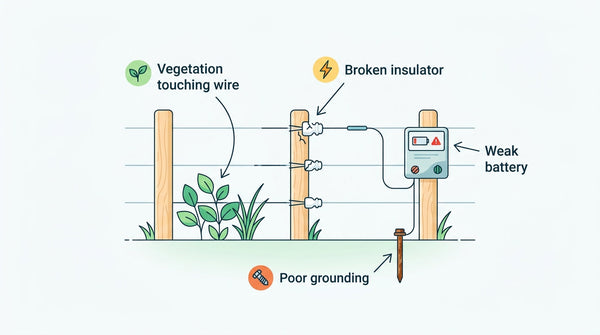
A blinking indicator confirms the charger is pulsing, not that the pulse is reaching the animals. Low voltage with a healthy LED almost always points to the fence side: a weak ground, a cracked insulator, vegetation shorting the bottom wire, or a bad splice in poly wire. Disconnect the fence lead and test at the terminal. If the terminal reads high and the fence reads low, walk the line.
Are cheaper fence chargers safe for children and pets?
Properly built pulsed energizers, regardless of price, deliver a very short shock measured in milliseconds, which is unpleasant but not injurious. The safety concern with budget units is not the pulse itself but poor construction or continuous-current designs, which are no longer sold by reputable brands. Look for a stated pulse interval, UL listing where available, and post warning signs where people can reach the wire.
Should a first-time buyer choose solar or plug-in?
Plug-in, if an outlet is within reasonable reach. AC units cost far less per joule, never run flat in a cloudy week and need no battery replacement. Solar makes sense for a remote paddock or rotational grazing where running a lead-out is impractical. A dual-power charger that accepts both AC and 12V input is the hedge, because it can start on mains and move to a battery and panel later without buying a second unit.
Final verdict
Spend on joules first. If $185 is workable, the Parmak Mark 8 will outlast and outperform everything else here. If the ceiling is $100, the VetraPulse 1J gives a full joule, outdoor sealing and battery or solar flexibility for $89.99, and nothing else in that bracket matches all three. Below that, pick by animal: Patriot or Zareba for horses, Happy Henhouse or FenceMate for a coop. Whatever the choice, drive two ground rods before blaming the charger.
Sources
- Parmak USA, Mark 8 product page: parmakusa.com/product/mark-8
- Pet Supplies 4 Less, Parmak Mark 8 listing with price: petsupplies4less.com
- VetraPulse, 1J 10kV Electric Fence Charger product page: vetrapulse.com
- Zareba Systems, 10 Mile AC Low Impedance Charger EAC10M-Z: zarebasystems.com
- Blain's Farm and Fleet, Zareba EAC10M-Z listing with price: farmandfleet.com
- Gallagher United States, M60 Mains Fence Energizer: shop.am.gallagher.com
- Gallagher Fence, energizer price list: gallagherfence.net
- Premier1 Supplies, electric fence energizers and solar sizing guidance: premier1supplies.com and solar energizer guide
- Patriot Global, PE5 Fence Energizer: patriotglobal.com
- Walmart, Patriot PE5 listing with price and warranty: walmart.com
- Amazon, Epoify 10 Mile Solar Electric Fence Charger: amazon.com
- Happy Henhouse, 0.25J 110V AC Electric Fence Charger: happy-henhouse.com
- Walmart, FenceMate AC Powered 5 Mile Electric Fence Charger: walmart.com
- Tractor Supply, American Farm Works 0.1 J 5 Mile AC Controller: tractorsupply.com