How to Choose the Right Electric Fence Charger for Your Farm
A practical, boots-in-the-mud guide to sizing, powering, and picking an energizer that actually holds your animals — written by people who fence pastures for a living.
Quick answer: Pick a charger by matching its output joules to your total energized wire length (roughly 1 joule per mile as a baseline), then size up for animal type, vegetation, and soil conditions — choose a plug-in charger if AC power is available, or a solar/battery unit for remote paddocks. Most small-to-mid-size farms do well with a 2–6 joule low-impedance charger.
📋 What's in this guide
🚜 Why the Right Charger Matters
Ask any longtime rancher what separates a fence that "mostly works" from one you never think about, and they'll point straight at the box on the post — the charger, also called an energizer. Everything else — the wire, the posts, the insulators — is just a delivery system. The charger is the heartbeat. Undersize it and your goats will find the one weak spot within a week. Oversize it without matching your fence length and grounding, and you're paying for power you'll never use.
We've walked a lot of pastures, and the pattern repeats: most "my animals keep escaping" complaints trace back to a charger that was picked by price alone, not by fence length, soil type, or the animal actually being contained. This guide breaks the decision down the way we'd talk it through standing at your gate, not the way a spec sheet does.

⚡ Understanding Joules (and Volts)
Two numbers matter on every energizer box: joules and volts. Voltage is the pressure that pushes a pulse through an animal's hide and hair — the higher the voltage, the more effectively it penetrates thick wool or a heavy winter coat. Joules are the energy behind that pulse — the "punch" that lets the shock travel the full length of your wire, through weeds, moisture, and resistance, and still arrive strong at the far end of the fence.
A widely used rule of thumb from agricultural extension research is to plan for roughly one output joule per mile of energized wire as a baseline, then add capacity for heavy vegetation, multiple hot strands, or poor grounding. Note the distinction between stored joules (what's built up in the capacitor) and output joules (what actually reaches your fence) — output joules are the number that matters, and they're typically lower than the stored figure because no transformer is 100% efficient.
| Term | What It Means | Why It Matters |
|---|---|---|
| Output Joules | Energy actually delivered to the fence line per pulse | Determines how far the shock travels through vegetation & wire |
| Stored Joules | Energy held in the capacitor before discharge | Useful only for comparing models within the same brand |
| Voltage | Electrical "pressure" pushing the pulse through the animal | Needs to stay above ~3,000–5,000V for a reliable psychological deterrent |
| Pulse Duration | Length of each electrical pulse (roughly 0.0003 seconds on a good unit) | Short pulses mean no fire risk, even in dry grass |
🔌 Plug-In vs. Battery vs. Solar Chargers
The three main charger types are all low-impedance designs today, which is a good thing — low-impedance chargers are safer and can push through weed contact without collapsing voltage. Where they differ is power source, portability, and ideal setting.
| Charger Type | Best For | Pros | Watch Out For |
|---|---|---|---|
| Plug-In (AC) | Permanent fences near mains power | Highest joule output for the price, no battery upkeep, most reliable | Needs a 110/220V outlet nearby |
| Battery (DC) | Temporary or rotational grazing paddocks | Fully portable, works anywhere | Battery life shorter than advertised; needs regular recharging |
| Solar | Remote, permanent fencing with no grid access | Self-sustaining once installed, low long-term cost | Higher upfront cost; needs adequate sun exposure |
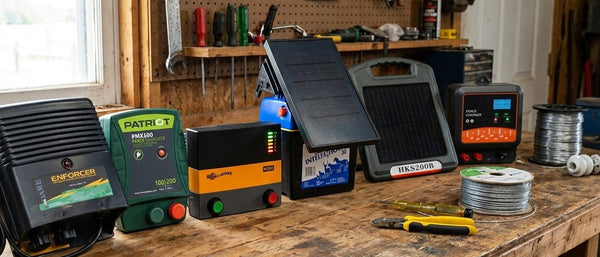
Rotational graziers moving stock between paddocks every few days generally do best with a compact battery or solar unit paired with lightweight electric netting that rolls up in minutes. Farms with a fixed perimeter and access to an outlet almost always get more shock for their dollar out of a plug-in charger.

🧭 5 Factors That Decide Your Charger Size
1. Total Fence Length (Not Acreage)
Joule requirements scale with miles of energized wire, not acres enclosed. A one-mile perimeter with four hot strands is really four miles of wire to power. Always add up every hot strand before you shop.
2. Animal Type & Hair/Wool Coverage
Thicker coats and hooves insulate against shock, so heavy-wool sheep and goats generally need higher voltage than short-haired cattle or horses to feel the same deterrent effect. Predator-deterrent fencing (coyotes, bears) typically needs both higher joules and higher voltage than standard livestock containment.
3. Vegetation & Weed Load
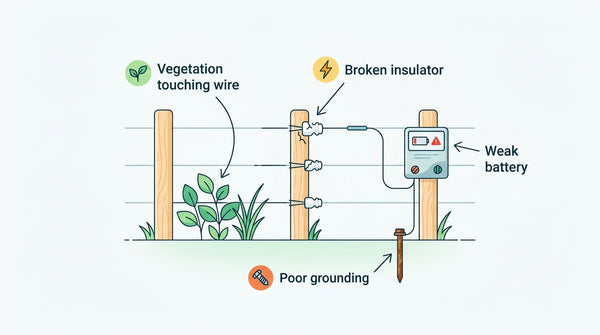
Grass and weeds touching the wire bleed voltage continuously. In fields that get mowed rarely, heavy growth can triple the effective joule requirement compared to a clean-cut line.
4. Wire Type & Conductivity
Polybraid and poly tape carry more electrical resistance than steel high-tensile wire, so longer poly runs need a stronger charger to maintain voltage at the far end of the line.
5. Soil Moisture & Grounding
An electric fence is only half the circuit — the ground return system is the other half. Dry, sandy, or rocky soil conducts poorly and needs more ground rods to complete the circuit effectively, regardless of how many joules your charger produces.
📊 Charger Sizing Chart by Animal & Fence Length
Use this as a starting baseline, then size up one tier if you have heavy vegetation, poly wire, or dry/sandy soil. These ranges reflect commonly cited extension and industry guidance for output joules under typical conditions.
Baseline output-joule ranges by animal type and use case. Always size up for heavy vegetation, long poly-wire runs, or dry soil. See sources below.
| Fence Length (energized wire) | Light Conditions | Heavy Vegetation / Poly Wire |
|---|---|---|
| Up to 1 mile | 1–2 J | 2–3 J |
| 1–3 miles | 2–4 J | 4–6 J |
| 3–6 miles | 4–6 J | 6–8 J |
| 6+ miles | 6–10 J | 10+ J |
⚠️ Common Mistakes to Avoid
- Buying by price instead of output joules. A cheap high-stored-joule unit with a weak transformer often delivers far less real power than its box suggests.
- Skimping on grounding. Extension research attributes the vast majority of underperforming fence complaints to inadequate grounding, not undersized chargers.
- Ignoring future expansion. Buying exactly what you need today means buying again next year when you add a paddock. Size up one tier if you plan to expand.
- Mixing wire types without adjusting for resistance. Long poly-wire runs need more output joules than the same length in steel high-tensile.
- Forgetting seasonal vegetation growth. A fence that tests fine in April can lose most of its voltage by July once grass reaches the wire.
Ready to size your fence the right way?
Browse energizers, netting, and fencing built for real farm conditions — chosen by output joules, not marketing numbers.
🔧 Seasonal Maintenance Tips
A correctly sized charger still needs upkeep to perform all year:
- Spring: Check ground rod connections after winter frost heave, and clear any dead vegetation touching the wire.
- Summer: Mow or spray under fence lines regularly — this is peak season for voltage loss from weed contact.
- Fall: Test voltage at the farthest point of your fence before winter; this is when you'll notice if grounding has degraded.
- Winter: For battery units, bring batteries in for charging in freezing conditions, as cold weather reduces effective capacity.
- Year-round: Keep insulators clean and replace any cracked ones — a single grounded-out insulator can drop voltage across the whole line.
🟢 Grounding-related issues (~80%) 🟡 All other causes combined (~20%) — including undersized chargers, wire faults, and weather damage.
❓ Frequently Asked Questions
How many joules do I need for a small backyard flock?
For a small poultry run or garden predator fence under half a mile, a compact 0.1–1 joule charger is usually enough, provided the netting or wire stays clear of grass and weeds. If you're deterring raccoons or foxes rather than just containing birds, lean toward the higher end of that range for a firmer deterrent.
Can I use one charger for multiple separate fence lines?
Yes, as long as all the hot wires are connected together and the combined total stays within your charger's rated output joules for the total wire length. Splitting power across disconnected, unrelated fence sections without adding capacity is a common cause of weak spots.
Do I need a bigger charger for wet climates versus dry climates?
Wet, well-drained soil actually conducts electricity better, which can slightly reduce the joules needed for solid grounding. Dry, sandy, or rocky soil resists conductivity, so those farms typically need more ground rods and sometimes a higher-output charger to maintain the same voltage.
Is a higher voltage always better than more joules?
Not exactly — they do different jobs. Voltage determines how well the shock penetrates hair, wool, or hide, while joules determine how far that shock can travel down a long or resistance-heavy fence line. A well-matched system needs adequate levels of both, not just one maxed out.
How often should I replace or upgrade my fence charger?
A quality low-impedance charger can last many years with basic maintenance, but it's worth reassessing anytime you expand your fenced area, add more hot strands, or notice consistently weak voltage at the far end of the line. Growing operations often outgrow their original charger within a few seasons.
Can solar chargers keep up with cloudy weather?
Most solar chargers include a backup battery sized to carry the unit through several cloudy days, but the panel and battery need to be matched to the charger's output joules. In consistently low-sun regions, oversizing the solar panel slightly is cheap insurance against voltage drops.
What's the safest way to test if my charger is properly sized?
Use a digital fence voltage tester at multiple points along the line — right next to the charger and at the farthest paddock corner. A healthy fence should read close to the same voltage at both ends; a big drop usually points to grounding, vegetation contact, or an undersized charger rather than a bad wire.
Does more fence charger power mean more risk to my animals?
Properly designed low-impedance chargers deliver a very short, sharp pulse rather than continuous current, which is what makes them a safe psychological deterrent rather than a sustained shock. Sizing up joules for a longer fence line doesn't meaningfully increase risk when using a compliant, well-built unit.
🌱 Final Thoughts
Choosing the right electric fence charger isn't about buying the biggest number on the shelf — it's about matching output joules to your actual wire length, accounting for your animals, vegetation, and soil, and backing it up with solid grounding. Get those fundamentals right, and a well-sized charger from the VetraPulse energizer collection, paired with quality fencing or netting, will quietly do its job for years without a second thought — which is exactly how a good fence should feel.
📚 Sources
- Thurlow, K., Guthrie, T., & Harrigan, T. — Considerations for Selecting & Installing an Electric Fence Charger, Michigan State University Extension. canr.msu.edu
- Electric Fencing: How to Select and Install an Energizer, Virginia Cooperative Extension, Virginia Tech. pubs.ext.vt.edu
- Electric Fence Design, University of Maine Cooperative Extension. extension.umaine.edu
- Gerrish, J. R., & Roberts, C. A. (Eds.). (1999). Missouri Grazing Manual, University of Missouri Extension.