Livestock Management · 2026 Guide
Electric Fence vs Traditional Fence:
What Every Livestock Owner Needs to Know
A comprehensive, evidence-backed comparison covering costs, safety, installation, and long-term value for farmers and ranchers.
Whether you manage a small hobby farm or thousands of acres of rangeland, your fencing system is the foundation of livestock safety, pasture management, and operational costs. The question isn't just about keeping animals in — it's about doing it smarter, cheaper, and with less daily labor.
Traditional fencing — wooden posts, barbed wire, woven wire — has served farmers for over a century. But modern electric fencing has fundamentally changed the equation. Today, ranchers across North America and Europe are making the switch, discovering that electric fences are a genuinely superior solution for most livestock containment needs.
In this guide, we'll break down every meaningful dimension of the comparison: upfront cost, installation effort, animal safety, portability, long-term maintenance, and environmental impact. We'll include real case studies, a comprehensive FAQ, and direct product recommendations.

7 Key Benefits of Electric Fencing Over Traditional Fencing
Let's examine the most important advantages electric fencing delivers — in practice, for working livestock operations.
|
💰
Dramatically Lower CostElectric fencing costs $0.05–$0.15 per linear foot, vs $1.50–$3.50 for wood post-and-rail — before labor. |
⚡
Psychological Barrier EffectAnimals quickly learn to respect the fence after a mild, harmless pulse — no repeated shocks needed. |
|
🔧
Fast & Easy InstallationOne person can install electric polywire fencing 5× faster than traditional. No heavy posts, no staples. |
🚚
Fully Portable & FlexibleMove your fence daily for rotational grazing. Polywire rolls up in minutes and redeploys instantly. |
|
🛡️
Predator DeterrenceHighly effective against coyotes, foxes, and dogs — far more so than standard woven wire fencing. |
☀️
Solar-Powered Off-GridSolar chargers eliminate grid dependency. Power remote pastures indefinitely with zero electricity bills. |
Head-to-Head Comparison
A direct comparison across the dimensions that matter most to livestock owners.
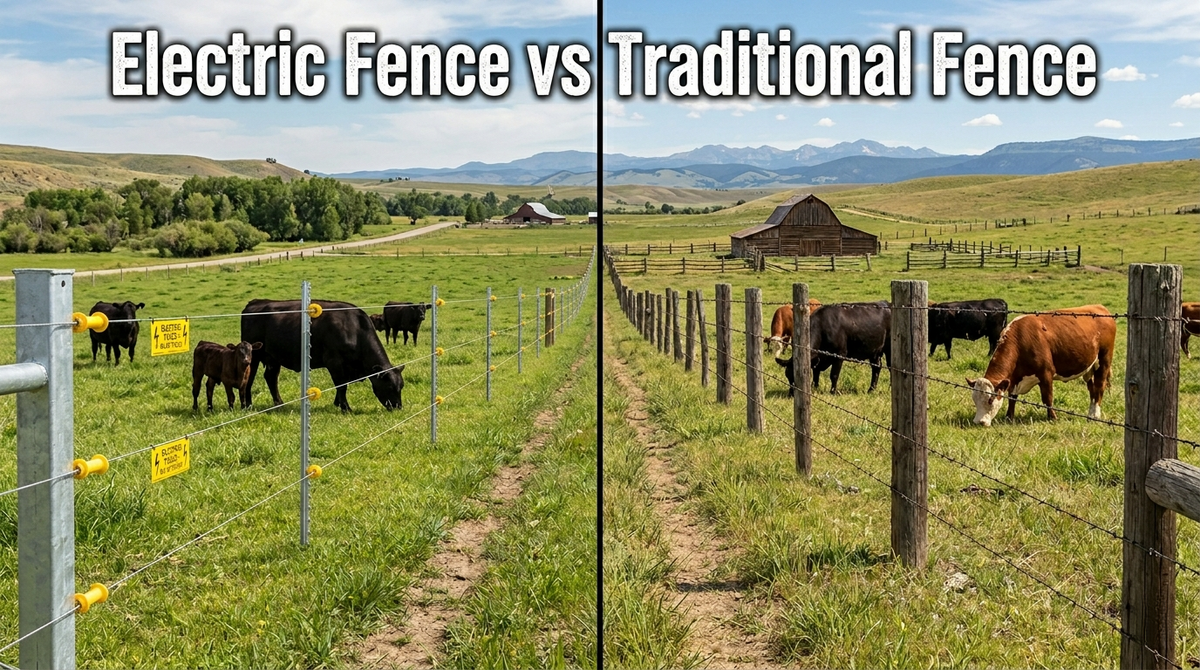
| Factor | ⚡ Electric | 🪵 Wood Rail | 🩹 Barbed Wire |
|---|---|---|---|
| Cost per 1,000 ft | $150–$400 ✓ | $1,500–$3,500 ✗ | $800–$1,500 |
| Installation Labor | Very Low ✓ | High (crew) ✗ | Moderate |
| Livestock Safety | Excellent ✓ | Good ✓ | Laceration risk ✗ |
| Predator Deterrence | Excellent ✓ | Moderate | Moderate |
| Portability | Fully portable ✓ | Permanent ✗ | Very difficult ✗ |
| Annual Maintenance | Very Low ✓ | High (rot) ✗ | Moderate (rust) |
| Rotational Grazing | Ideal ✓ | Not practical ✗ | Not practical ✗ |
| Solar Compatible | Yes ✓ | N/A | N/A |
Why Polywire Is the Smart Choice
Electric fence polywire — a composite of UV-stabilized polymer strands and stainless steel conductors — has become the material of choice for most modern livestock operations.
What Makes Polywire Different?
Unlike solid wire alternatives, polywire is lightweight, highly visible to animals, and extremely flexible. The polymer/metal blend gives superior conductivity while resisting UV degradation and rust.
- 2,625 ft (800M) rolls cover large acreage without frequent splicing
- 9 mixed metal strands ensure reliable conductivity across the full length
- UV-treated outer casing extends outdoor lifespan significantly
- Rust-resistant strands maintain performance in wet climates
- Bright color (orange or white) helps animals and humans see the fence
- Rolls up easily for storage and rotational grazing repositioning

⚡ Electric Fence Polywire for Livestock
2,625ft / 800M · 9 Mixed Metal Strands · UV + Rust Resistant · For Horses, Cattle & All Livestock
Built for demanding outdoor use, this polywire delivers consistent conductivity season after season — portable enough for rotational grazing, durable enough for permanent boundaries.
Shop Polywire →Going Off-Grid: The Solar Fence Charger Advantage
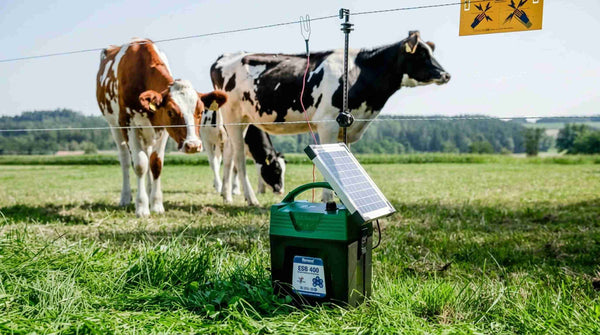
One of the most transformative innovations in modern livestock management is the solar-powered electric fence energizer. For remote pastures or any location without easy grid access, solar chargers eliminate the most significant limitation of electric fencing: power supply.
A solar fence charger uses photovoltaic panels to capture sunlight and store energy in an internal battery, powering the fence continuously — including at night and through overcast days.
| Situation | ☀️ Solar Charger | 🔌 Plug-In |
|---|---|---|
| Remote pastures (no grid) | ✓ Ideal | ✗ Not possible |
| Rotational grazing (moving fence) | ✓ Highly portable | ~ Limited by cord |
| Zero electricity cost goal | ✓ Free after purchase | ✗ Ongoing cost |
| Easy installation, minimal cables | ✓ Self-contained | ✗ Wiring required |

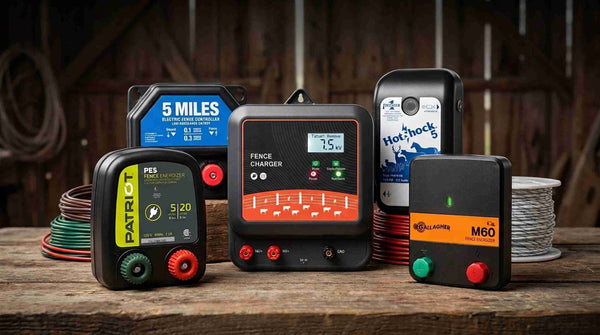
☀️ Solar Electric Fence Charger for Livestock
Grid-free energizer for remote pastures · Charges by day, powers all night · Compatible with polywire, polytape & steel wire
Mount it anywhere with sunlight and your fence is live — day and night, all season long. Handles horses, cattle, sheep, and goats.
Shop Solar Charger → Browse All FencingReal Farmer Stories: Electric Fencing in Practice
Real-world adoption tells a compelling story. Here are three case studies from livestock producers who made the switch.
680-Acre Ranch Cuts Fencing Cost by 64%
A cattle operation in central Texas needed to fence 3.2 miles of new perimeter. Traditional barbed wire quotes came in at $38,000. After switching to electric polywire with a solar-powered energizer, total cost dropped to $13,700 — with the family completing most installation themselves over two weekends.
Within one grazing season, rotational management improved average daily gain in their stocker cattle, and parasite load dropped as animals weren't continuously grazing the same ground.
Solar Energizer Solves Remote Pasture Problem
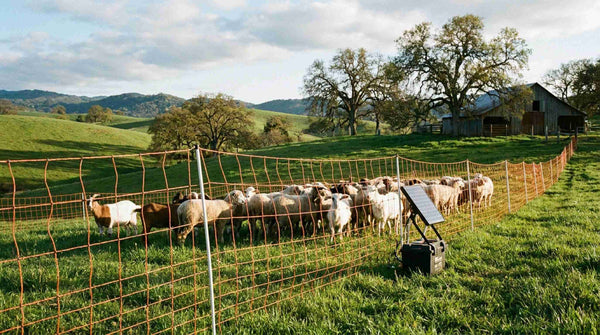
A small sheep producer in rural Oregon had always avoided fencing a 90-acre back pasture because grid power was unavailable. A solar electric fence charger and two rolls of polywire changed that entirely — completed in a single day, no trenching, no permits, no contractor.
The farmer reports the solar unit has operated reliably through three Oregon winters, maintaining sufficient charge to keep the fence live throughout even extended cloudy stretches.
Predator Pressure Solved with Electric Perimeter
A Wisconsin hobby farm raising laying hens and goats suffered repeated coyote incursions costing several animals per year. After adding a low-voltage electric polywire perimeter along the base of their existing woven-wire fence, predator incidents dropped to zero over the following 18 months.
The combined system required only two additional strands of polywire at ground level and a basic solar energizer — total investment under $400.
Installation Best Practices
Electric fencing is beginner-friendly — but a few key practices make the difference between a system that works reliably for years and one that causes frustration.
Frequently Asked Questions
Everything farmers and first-time buyers ask before making the switch to electric fencing.
Q: Is electric fencing safe for my livestock?
Yes — unequivocally. Modern energizers deliver a short, high-voltage, low-amperage pulse that is startling but not harmful. The pulse duration is typically 1/10,000th of a second. Animals quickly learn to avoid the fence without repeated shocks. Horses, cattle, goats, sheep, and poultry are safely managed with electric fencing worldwide.
Q: How does a solar charger work in cloudy weather?
Solar chargers include an internal rechargeable battery that stores energy collected during daylight. A fully charged battery can power most energizers for 3–7 days without any sun. During extended overcast periods, the charger draws from battery reserves — a slightly larger solar panel paired with a higher-capacity battery extends reliability in low-light climates.
Q: What is the difference between polywire, polytape, and steel wire?
Polywire is a round, lightweight conductor best for portable or semi-permanent fencing — highly portable, easier to splice, and less expensive. Polytape is wider (0.5–1.5 inches) and more visible, preferred for horses. High-tensile steel wire is used for permanent, high-output systems but is not portable. For most livestock owners, polywire offers the best balance of cost, conductivity, and flexibility.
Q: Can I use electric fencing for horses specifically?
Yes — electric fencing is widely considered superior to barbed wire for horses due to safety. Horses injured by barbed wire face serious laceration risks; electric fencing eliminates this danger. Highly visible polywire or polytape in white or orange is recommended so horses can clearly see the boundary. Most horses learn to respect electric fencing within 24–48 hours.
Q: How many acres can one solar fence charger power?
This depends on the energizer's output (in joules) and fence configuration. Entry-level solar chargers (0.05–0.15 joules) handle small paddocks up to 5–10 acres on a single wire. Mid-range units (0.5–1 joule) handle 20–50 acres. For large operations with multiple strands and heavy vegetation, higher output units are needed. Always size up rather than down.
Q: How long does electric fence polywire last?
Quality polywire with UV-stabilized polymer and rust-resistant metal strands (such as 9-strand mixed metal construction) typically lasts 5–10 years under normal conditions. Factors that reduce lifespan include prolonged UV exposure without UV protection, physical abrasion, and consistent high-voltage operation without periodic inspection. Rolling polywire up off-season significantly extends its useful life.
Q: Can electric fencing stop predators like coyotes and foxes?
Yes — effectively, when properly configured. For predator control, place a low strand at 6–8 inches from the ground (prevents digging) and a higher strand at 12–18 inches (discourages jumping). Multi-strand configurations along the base of existing fences are a low-cost, high-effectiveness predator deterrence strategy.
Q: Is electric fencing worth it for a small hobby farm?
Absolutely. Small farms arguably benefit most from electric fencing because the low material cost and ease of installation make it accessible to operations with limited capital and labor. A starter kit — solar charger, polywire, and step-in posts — can fence a small paddock for under $200, something that would cost $1,500–$3,000 in traditional materials.
Q: Do I need planning permission to install an electric fence?
In most rural US jurisdictions, electric fencing for agricultural use does not require planning permission. However, regulations vary by county and state — particularly for fences adjacent to public roads or shared boundaries. Check local ordinances and notify neighboring landowners as a courtesy. Warning signs are generally recommended and in some areas legally required.
Q: What maintenance does an electric fence require?
Key tasks include: checking voltage monthly with a fence tester, clearing vegetation from beneath the wire (the main cause of voltage loss), inspecting connections and insulators annually, and cleaning the solar panel surface periodically. Total time commitment is typically 1–2 hours per month for a well-set-up system.
Ready to Make the Switch?
Electric fencing isn't the future of livestock management — it's the present. Hundreds of thousands of farms across North America have already made the transition and are saving money, reducing labor, and managing their animals more effectively.
The two products that form the foundation of any high-quality electric fencing system are a reliable polywire conductor and a dependable energizer. For off-grid and remote operations, the combination of VetraPulse polywire and a solar-powered charger delivers everything you need in a single, easy-to-deploy package.